
BEST OF WORLD CINEMA | ACCORDING TO MAVI BONCUK
SILENT (1891-1936)
Part 1 (1891-1913)| Part 2 (1914-1919)
Part 3 (1920-1936)
SILENT TO SOUND (1926-1929)
SOUND (1926-2022)
Part 1 (1926-2022)| Part 2 (1930-1959)
Part 3 (1960-1979) Part 4 (1980-1999)
Part 5 (2000-2009) Part 6 (2010-2022)
TURKISH CINEMA
SILENT ERA | [IN PROGRESS ]
SOUND (1933-1999) | SOUND (2000 - 2022)

TILLIE'S PUNCTURED ROMANCE | 1914 MACK SENNETT
FANTOMAS AGAINST FANTOMAS | 1914 LOUIS FEUILLADE
THE SQUAW MAN | 1914 CECIL B. DEMILLE
THE PERILS OF PAULINE | 1914 LOUIS J. GASNIER, DONALD MACKENZIE
L’Amazzone mascherata sees Francesca Bertini in the role of Franca de Roberti, a woman who vows to clear the name of her husband after he is framed for treason. Here she is, appearing in the opening ‘credit sequence’ as both de Roberti and her alter-ego, the Masked Amazon. L’Amazzone mascherata’s main virtue, besides Bertini, is its coherent plot. It’s refreshing for having a female protagonist who drives the action and saves the day. It is more of an adventure story than a diva film; Franca de Roberti spends much more time in plot-driven, self-motivated action than she does in lounging around, emoting, etc. However, being a film starring La Bertini, many diva properties are still in effect.
Francesca Bertini was known to American audiences from several films: the highly-thought-of L’histoire d’un Pierrot 1913, released in the US as Pierrot the Prodigal; Venomous Tongues (Il veleno delle parole 1913); The Song of the Soul (La canzone di Werner 1914); and Rameses, King of Egypt (La rosa di Tebe 1912). SOURCE
THE OUBLIETTE | 1914 CHARLES GIBLYN
This film and By the Sun's Rays are two of Lon Chaney's
earliest surviving films. The Oubliette was considered lost until the summer of
1983 when a nitrate print in excellent condition was discovered in Georgia. A
couple rebuilding the steps of their front porch uncovered all three reels of
the film, still in their metal cans
TESS OF THE STORM COUNTRY | 1914 EDWIN S. PORTER
It stars Mary Pickford, in a role she would reprise eight
years later for the 1922 adaptation by John S. Robertson. The film first
released in US theaters on March 30, 1914, and was rapidly successful,
particularly in propelling the fame of its star, Mary Pickford, to new heights.
Distribution was handled by producer Daniel Frohman, one of the original
founders of the Famous Players Film Company. The film survives today due to the
preservation efforts of the Mary Pickford Foundation and the film archives of
UCLA.
The film was produced in 1914 by Adolf Zukor's Famous
Players Film Company with a budget of $10,000. One of the first feature films
to come out of early Hollywood, shooting was spread between the California
cities of Del Mar and Santa Monica.[5]
When Zukor gave Mary Pickford the script to Tess of the Storm Country, she had to be persuaded to take the lead role. The script was based on a successful novel of the same name by Grace Miller White, but it eliminated much of the book's moral pieties, complexity, and regional dialect. What was left—and what gave Pickford pause—was melodramatic, clichéd, and direct.
Pickford eventually accepted the role due to the popularity of White's novel, but she chaffed under Edwin S. Porter's direction. She later told a film historian that Porter "knew nothing about directing. Nothing." The aging Porter was still employing an outdated approach to film-making that worked so successfully him in films like The Great Train Robbery (1903). For example, he resisted using camera movement to his advantage, decorated his sets with painted backdrops, refused to take advantage of film's illusion of depth, and relied heavily on intertitles to deliver narrative. Pickford, one of the most influential pioneers in filmmaking and acting, was used to working collaboratively with directors and cinematographers to get the best shot. She was also adept at modulating for the camera, commanding attention within a frame, and enchanting audiences. While Porter refused to consider Pickford's suggestions, she delivered a stunning performance and helped turn the film into a resounding success. She later pointed to the film as "the beginning of my career."
1915
LES VAMPIRES | 1915 LOUIS FEUILLADE
The genre of crime serial was common at the time, and Feuillade had had a big success with his previous work, the serial Fantômas. It is suspected that production of Les Vampires began when Gaumont learned that rival company Pathé had acquired the rights to release the serial The Mysteries of New York,[10] known in America as The Exploits of Elaine,[11] and felt they had to fend off competition. Another American serial, The Perils of Pauline, had become massively popular since the release of Fantômas.

The idea of the criminal gang was possibly inspired by the Bonnot Gang, a highly advanced anarchist group who went on a high-profile crime spree in Paris during 1911–1912. Feuillade wrote the script himself, but did it in a very simplistic way, usually writing the premise and relying on the actors to fill in the details. Later episodes were more scripted, however.The style has been compared to that of a pulp magazine (which it was later serialized as.) In an essay on the film, Fabrice Zagury stated "...Feuillade's narrative seldom originates from principles of cause and effect... Rather it unwinds following labyrinthine and spiral-shaped paths." None of the episodes employ the cliffhanger mechanic, popularized by The Perils of Pauline.

The film employs tinting to describe the lighting: amber for daylight interiors, green for daylight exteriors, blue for night and dark scenes and lavender for low-lit areas (such as nightclubs or dawn). It is noted for its length, just under 400 minutes, and is considered one of the longest films ever made.
At the time of its release it was the second longest film ever made, behind the 1914 Christian film produced by the Watch Tower Bible and Tract Society of Pennsylvania The Photo-Drama of Creation by Charles Taze Russell (480 mins.)
Musidora saw a noticeable raise in her public profile after the film's release, becoming a star of French cinema. She was able to concentrate her career on directing and writing her own films. Édouard Mathé and Marcel Lévesque enjoyed lengthy film careers as a result of their performances. The three leads, as well as many other cast members, were re-cast by Feuillade to appear in his other serials such as Judex, Tih Minh, Barrabas and Parisette.
THE TRAMP | 1915 CHARLES CHAPLIN
THE CHEAT | 1915 CECIL B. DEMILLE
A FOOL THERE WAS | 1915 FRANK POWELL
FILIBUS | 1915 MARIO RONCORONI
CIVILIZATION | 1915 REGINALD BARKER, THOMAS H. INCE, RAYMOND
B. WEST
The film was a big-budget spectacle that was
compared to both The Birth of a Nation and the paintings of Jean-François
Millet. The film was a popular success and was credited by the Democratic
National Committee with helping to re-elect Woodrow Wilson as the U.S.
President in 1916. The film was also one of the first to depict Jesus Christ as
a character in a motion picture, leading some to criticize the depiction as in
"poor taste.
THE QUEEN OF SPADES | 1916 YAKOV PROTAZANOV
JUDEX | 1916 LOUIS FEUILLADE
THE DUMB GIRL OF PORTICI | 1916 LOIS WEBER

EAST IS EAST | 1916
HENRY EDWARDS
The full print of East Is East survives, and is well regarded by historians of British silent film. Writing for the British Film Institute, Bryony Dixon notes: "Edwards seems to have had an innate or instinctive understanding of cinema space both as an actor and director, and despite being hampered as everyone else at that early date by rather fixed sets and camera positions, he uses himself and the other actors to convey the space beyond the fourth wall, creating the illusion of a satisfyingly convincing world." She also notes: "The locations are well chosen and evocative of a bygone era, particularly the lovely scenes in the Kentish hop fields", and that Edith Evans in a very early screen role "outrageously upstages everyone at every opportunity". Although largely a serious drama, the film also includes scenes of visual humor arising from the awkward collision of East End and West End manners and habits.
HOMUNCULUS | 1916 OTTO RIPPERT
Screenplay by Robert Reinert. With Olaf Fønss, Ernst Ludwig, Adolf Paul, Alfred Paul, Theodor Loos. Long believed lost except for a single chapter, this astounding science-fiction serial is the German Fantômas and then some—the story of a laboratory-created superman (played in brooding, romantic fashion by Olaf Fønss) who is at once a master criminal and a Christ figure. Painstakingly reconstructed from fragments discovered in seven film archives by Stefan Droessler of the Munich Filmmuseum, the six-part film is filled with the neuroses that would explode into Expressionism and charged with the political contradictions that would lead to National Socialism. Reconstruction by the Munich Filmmuseum.

Homunculus, produced by Deutsche Bioskop in 1916, is a six-part serial science fiction film involving mad scientists, superhuman androids and sinister technology. The script was written by Robert Reinert, and the film foreshadows various elements of Fritz Lang's 1927 Metropolis, as well as serving as a model for later adaptations of Mary Shelley's Frankenstein rather than the original 1910 version. The subject-matter of Homunculus is similar to an earlier film about a monstrous man-made being, Der Golem (Paul Wegener, 1915).
Fritz Lang wrote the script for Rippert's historical epic The Plague of Florence (1919), feature the black plague. The cameraman was Emil Schünemann, who was behind the lens for In Nacht und Eis. After 1924, Rippert stopped directing films and worked as a film editor.
THE HALF-BREED | 1916 ALLAN DWAN

Ostracized from white society, Lo Dorman, a half-breed, lives in the forest on the outskirts of town with his adopted Indian grandfather. While there, he meets another outcast, Teresa, who has run away from authorities after stabbing her unfaithful lover. Seeing her from a distance, Sheriff Dunn mistakes Teresa for Nellie, his sweetheart, and, believing that she has begun an affair with Lo, decides to kill him. Because she has gone through some of Lo’s possessions, Teresa knows that Dunn is really his father, but as she tries to explain this to the sheriff, a forest fire breaks out. Lo tries to rescue both Teresa and Dunn, but finally must make a choice between them, and, unaware of their relationship, decides to leave Dunn to die. He is able to save Teresa, whom he later marries. American Film Institute
When Douglas Fairbanks, Allan Dwan, and Anita Loos adapted Harte’s novella as The Half-Breed in 1916, the poetic idea of the Noble Savage was perhaps less in vogue than the 19th century notion that Native Americans were just plain savage.
The real story is not Lo’s parentage, but the triangle of Lo, Nellie, and Sheriff Dunn. “Although the film runs through the standard white woman-Indian man plot points, it rewrites them with sharp satire,” says scholar Scott Simmons in his 2003 history of the genre, The Invention of the Western Film. Anita Loos, who wrote Half-Breed’s scenario, might have been at least partially responsible for turning the stereotype of the virginal white woman and the rapacious redskin on its head. Nellie’s brazen pursuit of Lo seems to belong to the flapper frankness of the 1920s rather than to pre-World War I Victorian morality.
The film follows a common strategy of exposing racism and then evading a real confrontation with its consequences—in this case, by revealing Nellie to be a heartless coquette and providing Lo with a more worthy love interest, Teresa, who, as both a Mexican and an outlaw, is his social equal. Yet it’s unfair to condemn the film for its inability to transcend its time period’s prejudices. The Half-Breed is still, as Frederic Lombardi writes in his 2013 book Allan Dwan and the Rise and Decline of the Hollywood Studios, “the most original and risky of Fairbanks’ Triangle features.”

See also: Film restorer Robert Byrne discusses the project to restore Allan Dwan's THE HALF-BREED (1916).
SHOE PALACE PINKUS | 1916 ERNST LUBITSCH

“Lubitsch’s films are therefore linked to the Jewish milieu not
only through their use of ‘Jewish humor’, or their depiction of the social and commercial
circles typical of Jewish life in Berlin at the time, but also – and more
importantly – through their emphasis on the issue of assimilation and the
conditions that enable it. His films introduce characters who endeavor to
overcome their ‘inherent’ social status and integrate into other, more esteemed
social groups. Employing clearly stereotypical features, Lubitsch depicted
these characters’ efforts to conceal these features and take on new behavioral
codes and a new appearance. The attempts to ‘buy’ aristocratic status –
traditionally inaccessible to Jews – or to pretend to be part of German
mountaineering culture, seem to support the argument that Lubitsch’s
protagonists are foreign to ‘German nature’ and to the German cultural
tradition, and that their efforts to integrate are in vain.” ( Kalbus, O.
1935.Vom Wesen deutscher Filmkunst, vol. 1. Altona: Bilderdienst.)
“German film provided a forum in which Jews negotiated different models of masculinity and nationhood, as well as a site where “internal” Jewish discourses surfaced within German popular culture.” ( Nicholas Baer Messianic Musclemen Homunculus (1916) and Der Golem (1920) as Zionist Allegories)
Hailed by the likes of Alfred Hitchcock, Francois Truffaut
and Orson Welles as a giant among filmmakers, Ernst Lubitsch was a preeminent
figure in the history of cinema who directed some of Hollywood's most
sophisticated and enduring comedies. More than a great director of actors and
action, he added his own personal signature - known as the "Lubitsch
touch" - to all his work, a sense of style and grace that was rarely
duplicated on the screen. After making a name as a director in his native
Germany, Lubitsch was brought over at the behest of star Mary Pickford to
direct her in "Rosita" (1923). From there, he made comedies like
"The Marriage Circle" (1924) and "Kiss Me Again" (1925), as
well as dramas like "The Patriot" (1925).
DIANA L'AFFASCINATRICE | 1916 GUSTAVO SERENA
It’s a treasured spy cliché – the agent who falls in love with their mark. In Diana l’affascinatrice, Francesca Bertini plays a woman torn between her espionage duties and her love for the good Captain Argo (Gustavo Serena, doing double duty as actor and director). Film history hasn’t remembered this film, and if it didn’t star Francesca Bertini it wouldn’t be notable at all; even so, it’s one of her minor films. But even though the plot is total boilerplate, she does very good work in Diana l’affascinatrice. Much is made of Bertini’s realism, and rightfully so, but watching this film you see why she deserves the title of diva. Diana l’affascinatrice was never distributed in America, although it circulated in Spanish-speaking countries under the title Diana la fascinadora – via the Media History Digital Library, references can be found in Cine-Mundial, the Spanish-language offshot of Moving Picture World.
In the Netherlands, the film circulated under the titles Diana, de vrouwelijke spion (the female spy) and Diana, de verleidster (the temptress), and it screened in centres across the Netherlands. The film is preserved by Cinematek (the former Cinémathèque Royale Belgique), where it survives under its French-language title Wanda l’espionne.
NOTTE DI TEMPESTA | 1916 GUGLIELMO ZORZI
Saved by Cinémathèque Royale de Belgique (Cinematek).
Almirante Manzini was a major diva of the Italian silents. Almirante Manzini began her acting career on the stage, and entered films in the early teens, but it was the mighty Cabiria (Itala-Film, 1914) that established her as a cinematic star. As is well known, Cabiria was groundbreaking both formally and narratively, and it’s still highly enjoyable. Almirante Manzini is resplendent as the Carthaginian noblewoman Sofonisba (a character based on the historical figure Sophonisba), living in luxury, complete with pet tiger.
Some film historians have described Almirante Manzini as the ‘matronly’ diva. She is not especially older than her contemporaries, born in 1890, she’s younger than Lyda Borelli, Hesperia, and Soava Gallone, the same age as Menichelli, and 2-3 years older than Francesca Bertini, Leda Gys, and Maria Jacobini.
After Almirante Manzini was dethroned by Pina Menichelli as Itala’s prima attrice in 1915/16, she worked for several different studios, where she was directed by some of the leading names in Italian film (e.g., Augusto Genina, Febo Mari). In the twenties, she worked primarily for Fert-Film and Alba-Film, usually directed by her cousin, Mario Almirante. Her career saw a number of big successes, and she was considered a major film diva until she left the screen in the twenties, only returning for a single talkie in 1934.
THE CURSE OF THE QUON GWON |1916 MARIAN E. WONG
Filmed circa 1916 or 1917, it was never released and long
thought lost. Two reels of an estimated total of seven or eight survived and
were restored, rendering the film incomplete.
Marion E. Wong created the Mandarin Film Company in Oakland,
California and served as its president. In an interview with the Oakland
Tribune in 1916, she expressed her interest in presenting Chinese culture to
American audiences through film. She produced, directed and wrote the
screenplay for The Curse of Quon Gwon, the only film her company made. The film
tells a love story featuring Wong's sister-in-law, Violet Wong, as the female
lead, and Wong herself as the film's villain. Other members of Wong's family
also had roles in the film. According to Violet Wong's grandson, Gregory
Mark, the film was turned down from distribution.
In 1969, Violet Wong told her grandson Gregory Mark about a film canister in the basement of the family home and said: "You do something with it." Mark turned it into 16mm, and a few years later, Violet showed the film to her family. In 2004, filmmaker Arthur Dong learned of two nitrate reels and the 16mm print containing footage from The Curse of Quon Gwon that were in the possession of Violet Wong's descendants while researching his documentary film Hollywood Chinese. He was given access to the footage and took it the Academy Film Archive, which restored the film in 2005.[ As of 2007, it is the earliest known Chinese American feature film and it is also one of the earliest films directed by a woman, Marion E. Wong. Most of the film remains missing.
THE POOR LITTLE RICH GIRL | 1917 MAURICE TOURNEUR
THE KING OF PARIS | 1917 YEVGENI FRANZEVICH BAUER
HÁROM HÉT | 1917 MÁRTON GARAS
THOMAS GRAAL'S BEST FILM | 1917 MAURITZ STILLER
MAN THERE WAS | 1917 VICTOR SJÖSTRÖM
THE POOR LITTLE RICH GIRL | 1917 MAURICE TOURNEUR
THE DYING SWAN | 1917 YEVGENI FRANZEVICH BAUER
REBECCA OF SUNNYBROOK FARM | 1917 MARSHALL NEILAN
IN THE BACCHANAL OF DEATH | 1917 RICHARD EICHBERG

 The Bacchanal of Death, also subtitled The
Sacrifice of a Great Love, was written in January/February 1917, passed the
film censorship in March of the same year and premiered on April 20, 1917 in
the Union Theater in Berlin. A youth ban was issued. The length of the four-act
play was about 1500 meters.The sets were designed by Robert A. Dietrich.
The Bacchanal of Death, also subtitled The
Sacrifice of a Great Love, was written in January/February 1917, passed the
film censorship in March of the same year and premiered on April 20, 1917 in
the Union Theater in Berlin. A youth ban was issued. The length of the four-act
play was about 1500 meters.The sets were designed by Robert A. Dietrich.
"Ellen Richter plays the abandoned muse of an artist who,
out of jealousy, instigates the murder of a man devoted to her (Werner Krauss).
Director Richard Eichberg “knows how to make this material extremely effective.
In all her passion, Ellen Richter lets all the strings swing.” (The film, April
21, 1917)
"The title Das Bacchanal des Todes (The Bacchanal of Death) promises a 'Sensationsdrama', a film of strong colors, violent emotions, exciting dangers and sexy women. And truly the rich chromatic and figurative substance of the film, as well as its magnificent lighting effects, are still a feast for the gaze today. Ellen Richter (nee Käte Weiss), who plays the dancer Lona, was a true silent film star, later forgotten along with her 60 blockbuster films - none of which she would have made it into the canon set by Lotte Eisner. . A dark Hungarian beauty, Richter was often cast for exotic roles, women called Juanita, Zoraya, Leila or Smaragda Naburian. Vittorio Martinelli writes that her 1922 Lola Montez film, directed and co-produced by her husband Dr. Wolff, was a rather beautiful film, well received and reviewed throughout Europe.
Forgotten like Ellen Richter, director-producer Richard Eichberg for twenty-five years supplied the German-speaking market with a large amount of action films, thrillers, exotic melodramas and romantic comedies. More importantly, he was a formidable talent scout and launched the careers of Ellen Richter, Lillian Harvey, Martha Eggerth and Hans Albers, some of the most popular stars in German cinema. When Anna May Wong arrived in Europe in 1928, fleeing Hollywood racism, Eichberg cast her on the spot and directed her in three highly successful films. Five years later, in 1933, Dr. Wolff was attacked by fellow Germans in front of a Berlin cinema, and it was his turn to leave his country, along with Ellen Richter." SOURCE Mariann Lewinsky
 THE LITTLE PRINCESS | 1917 MARSHALL NEILAN
Based upon the 1905 novel A Little Princess by Frances Hodgson Burnett. This version is notable for having been adapted by famed screenwriter Frances Marion. Mary Pickford played a 10-year-old here when she was 25. I could barely pass for 10 when I was 10 years old. Little Sara Crewe is placed in a boarding school by her father when he goes off to war, but he does not understand that the headmistress is a cruel, spiteful woman who makes life miserable for Sara.
THE WAR AND THE DREAM OF MOMI | 1917 SEGUNDO DE CHOMÓN
“Co-directed” with Giovanni Pastrone of CABIRIA (1914) fame, THE WAR AND THE DREAM OF MOMI was made in Italy, clearly, during World War I. It is just barely a feature film by the traditional sense of the term, running a total of 40 minutes. Pastrone likely directed the live action sequences, in which a grandfather tells a grandson about the war. But when he falls asleep, the child dreams about stop motion toy soldiers going about their miniature warfare. This is where de Chomón came in, providing special effects for various films across Europe after his own directorial career effectively ended in 1912. As far as I can tell, this is the only directorial credit de Chomón ever received for a “feature” film, or indeed for his special effects contributions alone. SOURCE
A Faustian tale about an old woman who makes a pact with Mephisto to regain her youth, but in return she must stay away from love. After making the deal, she meets two brothers who fall in love with her. Relatively obscure today, Rapsodia Satanica has been lauded by critics as one of the crowning achievements of early Italian cinema. Sadly, Nino Oxilia's finest contribution to cinema would also prove to be his last. He was killed in action just a few months after Rapsodia was released, succumbing to a shrapnel wound sustained during the first battle of Monte Grappa in November 1917.
“Integral to this grand design was the casting of Lyda Borelli as the Contessa Alba d'Oltrevita (literally, 'dawn-before-life'). Borelli was massively popular in her heyday, even contributing to the language as the word 'Borellismo' was used to describe the particular style and manner adopted by her legions of followers. Her exaggerated acting style, all grandiose gestures and sensuous movement, suited perfectly those films whose directors needed an icon rather than a leading lady. Her larger-than-life image made her one of cinema's first true stars; when she retired in 1918 after her marriage to Count Vittorio Cini, her public was devastated.
Borelli is undoubtedly the focal point of the film, which takes care never to let reality intrude on its picturesque world. Careful lighting and composition give many scenes the look of a Pre-Raphaelite painting, through which Borelli and Ugo Bazzini as her tormentor glide like phantoms. Scenes unfold against a backdrop of ornate gardens and lavish ballrooms, at the time a common feature of similar tales of the aristocracy which came to be known as 'tail-coat films'. An extra dimension is added by the vivid colours, created through a time-consuming stencilling process known as 'pochoir', which gave a richer result than the customary tinting.” SOURCE
'49-'17| 1917 RUTH ANN BALDWIN
It was the first Western directed by a woman. Baldwin began
work on writing and directing a silent film called '49–'17, in 1917. The film
was five reels, and according to The New York Clipper, it was "being
produced on a more elaborate scale than any play she has yet handled".
Based on the short story "The Old West Per Contract", it starred
Joseph Girard and Leo Pierson. "Beyond its irrefutable historical
significance, '49–'17 stands out for its clever reworking of traditional
Western mythology at a time when the cinematic genre was still in its
infancy". (Gallagher, Cullen , July 27, 2009)
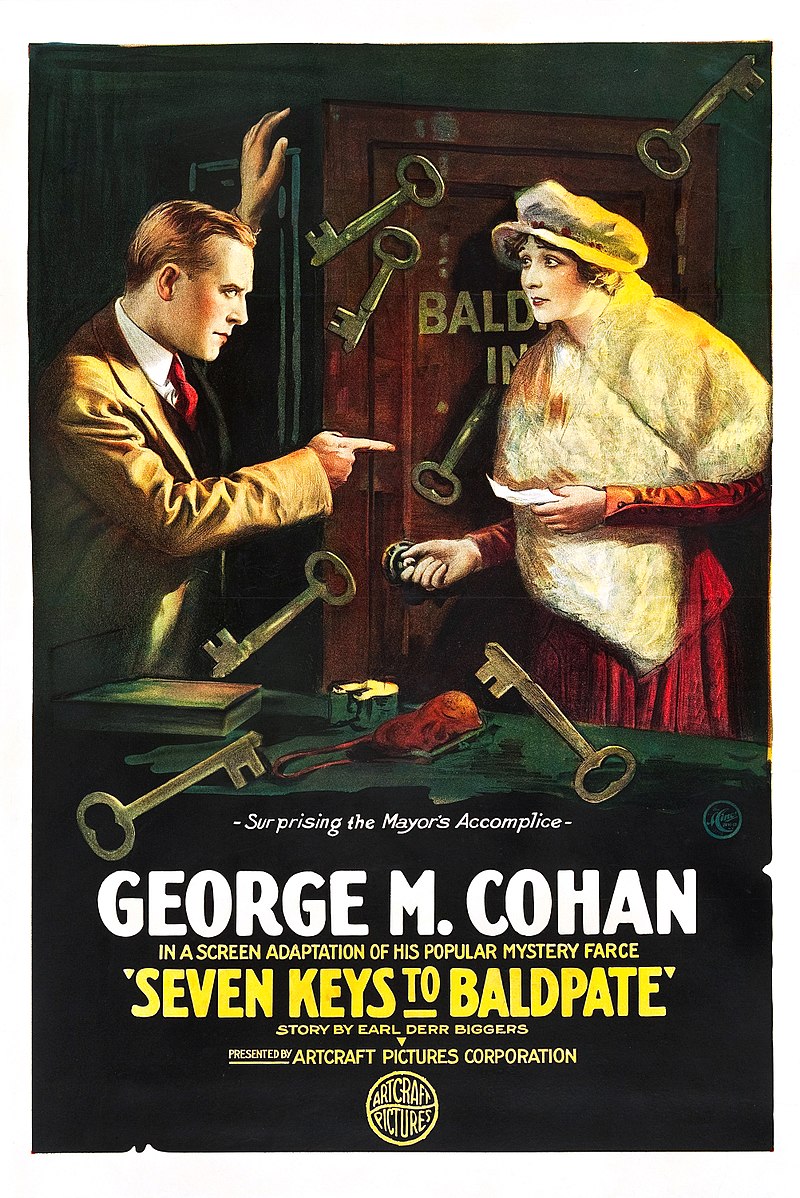
American silent mystery/thriller film produced by George M. Cohan and distributed by Artcraft Pictures, an affiliate of Paramount. The film is based on Cohan's 1913 play of the 1913 novel by Earl Derr Biggers. Cohan himself stars in this silent version along with Anna Q. Nilsson and Hedda Hopper, billed under her real name Elda Furry. It is in public domain and a print exists.
A writer of melodramatic novels takes a bet that he can write a novel in 24 hours and is allowed to use Baldpate Inn as his place to do this as it is closed and he is unlikely to be interrupted. However, (as is obvious from the title), he doesn’t have the only key to Baldpate inn…
THE POOR LITTLE RICH GIRL | 1917 MAURICE TOURNEUR
American comedy-drama film directed by Maurice Tourneur.
Adapted by Frances Marion from the 1913 play by Eleanor Gates. The Broadway
play actually starred future screen actress Viola Dana. The film stars Mary Pickford, Madlaine
Traverse, Charles Wellesley, Gladys Fairbanks (returning from the play) and
Frank McGlynn Sr.
The film was shot in Fort Lee, New Jersey when early film studios in America's first motion picture industry were based there at the beginning of the 20th century. In 1991, The Poor Little Rich Girl was deemed "culturally, historically, or aesthetically significant" by the United States Library of Congress and selected for preservation in the National Film Registry.
THE SULTAN'S WIFE | 1917 CLARENCE G. BADGER


KING OF PARIS / KOROL PARIZHA | 1917 YEVGENI BAUER
Russian silent feature film shot in the cinema factory of
Aleksandr Khanzhonkov in Yalta. This was the last work of Yevgeni Bauer. As he
worked on his previous film, For Happiness, Bauer broke his
leg, and he shot this film while in a bathchair, but soon fell ill with
pneumonia. He began shooting in early summer of 1917, but he was soon placed in
Yalta hospital and on 9 June 1917 he died. Actress Olga Rakhmanova finished the
film.
NÄR KAPTEN GROGG SKULLE PORTRÄTTERAS| 1917 VICTOR BERGDAHL
Gustav Victor Bergdahl was the first man in Sweden to make
animated cartoons. Prior to going into animation, he worked as an illustrator
for many humorous magazines. Inspired by Winsor McCay, he created his own
animation technique, and in 1915, his first cartoon was shown in the cinemas.
Not nearly as wacky-surreal as Koko The Clown, but when Captain Grogg has his portrait painted, he takes violent offence to the finished piece. However, gaining vengeance proves impossible, thanks to the artist's prodigious physical dexterity. Bergdahl's innovative mixed-media short treats both its filmed and drawn elements as if they were animated, with the result proving something of a minor masterpiece of comic editing.

Temporarily freed from her tyrannical husband, the beautiful wife learns about true love.
The posters of Három hét (Three Weeks) proudly announced the "sensational event of the week", the "first real Hungarian blockbuster". Advertised as a romantic movie, the melodrama was really considered an unadulterated mass film of the era. The script was written based on a sultry novel by a well-known English writer Elinor Glyn. The audience's favorite, Sári Fedák, played the main role. The film is one of the first productions of Hungária Filmgyár, which was founded not long ago. Márton Garas was the director of the company. French Raymond Pellerin came from the Gaumont Film Factory to be the cinematographer. The Hungária Filmgyár is notable primarily because such legendary actors of the era as Gizi Bajor, Uray Tivadar or Irén Varsányi received contracts here.
Three Weeks was one of the biggest successes of the film industry. Not much later, in the early twenties, the crisis in domestic film production swept this company away as well. Elinor Glyn was a pioneer of romance novels aimed at female readers. Her stories of marriage and female subordination, rejecting rigid conventions and imbued with subtle erotica, caused scandals at the time of their publication. The Three Weeks dissects similar topics, by emphasizing female sexuality, it was considered progressive and daring in its time.
Márton Garas is an important figure in Hungarian silent film production. He started his career as an actor, among other things he played in Berlin. He also gained his first experiences as a filmmaker there. After his return home, the founder of Cluj film production, Jenő Janovics, entrusted him with directing duties. Between 1915 and 1921 he made dozens of films. He worked in the leading film factories of the era. In 1921 he emigrated to Germany.
Three Weeks was a resounding success. The critics
of the time received it with great enthusiasm, the newspapers highlighted the
energetic playing of Fedák Sári in particular. The audience was also a fan of
the twisted melodrama. According to reports, the audience applauded and cheered
during the screenings, and the tickets sold out days in advance. A copy of
Three Weeks with German intertitles was found in the collection of the
Filmmuseum in Berlin. The restored version was made in 2003. The Hungarian
inscriptions were based on the extant German version, Glyn's novel, and reviews
of contemporary newspaper articles. The film - in addition to its period
documentary value - is permanent because of the totals and spectacular crowd
scenes that move the actors on several levels.

The circus
clown Joe Higgins (Valdemar Psilander ) is scouted by a world-famous artist
agent, who promises him fame and fortune. Joe takes the offer on one condition:
His fiancée Daisy and her parents are coming with him. Soon, Joe finds himself
performing on the biggest stages in the city, enthralling his audience night
after night. But the glamorous life in the big city is no fairy tale after all.
Back when film production gained momentum after the founding of Nordisk Films Kompagni in Copenhagen and Fotorama in Aarhus in 1906, cinema – a brand-new invention at the time – was so widely despised as a mere flash in the pan that actors with theatrical ambitions insisted on appearing anonymously on film.
Anyone who knows just one Danish silent film star is far more likely to remember Asta Nielsen than Valdemar Psilander. Valdemar Psilander was an idol to ardent female admirers around the world, in 1913–14 Russian and German film magazines proclaimed him their readers’ absolute favourite actor, his salary at Nordisk Films Kompagni was astronomical compared to the wages given to other actors, and he unapologetically demanded exorbitant raises. In return, the company profited just as much from his star status. Psilander’s career coincides with the star system having its international breakthrough. The Germans have ‘Die Asta’ and Henny Porten, the Frenchmen have Max Linder, Hollywood has Mary Pickford and Florence Lawrence and Denmark, which is among the largest producers in Europe at the time due to Nordisk Films Kompagni, has Valdemar Psilander.
He made more than 83 films in just six years before he was found dead in his hotel room in Copenhagen at the age of 32. He became a world star in record time and died with just 10 kroner in the bank and 188 kroner in cash in his pocket. SOURCE

THE TORTURE OF SILENCE | 1917 ABEL GANCE
Intense melodrama
about the despair born of silence and secrets. Feeling neglected by her husband, the busy Dr. Edward
Courand, Martha Courand sends a heart-felt and pleading love letter to their
friend Claude Gallatin. A letter that will set off unforeseen tragedies and
prompt a lifetime of torturous secrets.
_1.jpg)
Cortez sends Alvarado to Montezuma who throws him into a dungeon from which he is rescued by Tecza who loves him. He is recaptured when her lover Guatemoco finds Alvarado hiding in her chambers. Tecza next leads Cortez into the city, thus causing the destruction of her nation and securing the love of Alvarado.. Print exists in the George Eastman Museum film archive [35mm positive] Wallace Reid (Alvarado); Raymond Hatton (Moctezuma); Hobart Bosworth ( Cortez); Theodore Kosloff (Guatemoco)[*]
[*] See also: Theodore Kosloff & Cecil B. DeMille | Meet Madam Satan by Debra Levine
The essay explores a rare and unknown 40-year professional
and personal relationship between Russian ballet dancer Theodore Kosloff
(1882-1956) and Hollywood director Cecil B. DeMille (1881-1959) told through
the prism of the making of DeMille’s Madam Satan (mgm 1930). It tracks
Kosloff’s colorful career as a dance entrepreneur, from his Bolshoi Ballet
beginnings, to his appearance in the premiere Paris season of Diaghilev’s
Ballets Russes, to his eventual relocation to Los Angeles where, starting in
1916, he was an acclaimed character actor in nearly 30 silent movies, primarily
directed by DeMille. At the outset of the Depression, with the advent of sound
in cinema, DeMille relied upon Kosloff as an artistic advisor to bring to
fruition Madam Satan his first and only movie musical. The essay analyzes the
high-art roots of Kosloff’s bizarre and exceptional ballet mécanique, Madam
Satan’s central dance number staged in a moored zeppelin.
ASHES/CENERE | 1917 FEBO MARI, ARTURO AMBROSIO
It is adapted from the 1904 novel by the Nobel Prize-winning
Sardinian writer Grazia Deledda. It is notable as the only film performance by
the Italian theater star Eleonora Duse. Rosalia Derios is an unmarried woman in
a small Sardinian village whose lover abandons her before the birth of their
son, whom she names Anania. Realizing that she will not be able to raise the
child properly, she gives full custody of Anania to her former lover. However,
she entrusts the boy with a sacred amulet before she leaves. Anania grows to
adulthood and retains possession of the amulet, but he is haunted by his
mother’s absence and tries to locate her. He pushes aside his career prospects
and cancels his plans for marriage in order to pursue his search for Rosalia.
Anania's search proves successful and he locates his mother but Rosalia cannot
take the shock of being reunited with her adult son and kills herself.
Duse co-wrote the screenplay for Cenere with Febo Mari, her director and co-star. The film was shot over a four-month period on locations across Sardinia. Duse initially had hopes for Cenere to open a new career in film acting. But upon seeing the finished film, she was disappointed in both the production and her performance.
When Eleonora Duse was approached in 1916 to appear in a film adaptation of Cenere, she had been absent from performing on stage for seven years. Duse expressed deep respect for the source material and its potential as a film. She later explained her return to acting in this production by stating: “I have been persuaded to create the character of Rosalia Derios, from the novel by Grazia Deledda, because it seemed to me that in the sorrowful figure of the mother, all sacrifice for her son, a figure moving in an austere and solemn landscape, would assume the total and clear plastic and spiritual significance that the silent theater must force itself to realize.”
Duse initially had hopes for Cenere to open a new career in film acting. But upon seeing the finished film, she was disappointed in both the production and her performance.

Written by Frances Marion and based on William John Locke's 1913 novel of the same name. The film stars Mary Pickford in dual roles as the title character and an orphan servant. Stella Maris is a beautiful, crippled girl, who is cared for by a rich family. They shield her from the harsh realities of the world, so that she has no idea of the cruel things that some people do. Unity Blake is a poor orphan all too familiar with the harsh realities of the real world. These two young women both fall in love with John, love which is complicated by the fact that he is still married to (though separated from) a bad wife.
[*] Born in San Bernardino, California, Neilan was known by most as "Mickey." Following the death of his father, the eleven-year-old Mickey Neilan had to give up on school to work at whatever he could find in order to help support his mother. As a teenager, he began acting in bit parts in live theatre, and in 1910 he got a job as chauffeur, driving Biograph Studios executives around Los Angeles to determine the suitability of the West Coast as a place for a permanent studio.

At the end of 1916, Neilan was hired by Mary Pickford Films
where he directed Pickford in several productions including Rebecca of
Sunnybrook Farm and The Little Princess in 1917, plus Stella Maris in 1918,
Amarilly of Clothes-Line Alley, M'Liss in 1918, and Daddy-Long-Legs in 1919.
A DOG'S LIFE| 1918 CHARLES CHAPLIN
SHOULDER ARMS | 1918 CHARLES CHAPLIN
THE COOK | 1918 ROSCOE “FATTY” ARBUCKLE
THE ESKIMO BABY | 1918 WALTER SCHMIDTHÄSSLER
Young Polar Explorar brings Eskimo Ivigtut to his parents in
Berlin. After experiencing Western culture, she finds herself pregnant but the
explorer comes to her rescue.

From the originally 1489 meter long film, a 1125 meter long nitro copy with Danish subtitles has been preserved in Det Danske Filminstitut. The film was restored by 2000, whereby a duplicate negative with German intertitles was made from the Danish copy in cooperation with the Deutsche Kinemathek. The German version finally formed the starting material for the publication: The film was released on DVD with new music by Maud Nelissen in 2012 with three other Asta Nielsen films as part of the Edition Filmmuseum series of the Munich Film Museum.
Contemporary criticism praised Das Eskimobaby and Nielsen's performance: In the film, she reveals "all her fine art of design and amazing beauty" and gives "a wealth of downright overwhelming moments, so that one can only say: everyone should see this film!" Other critics felt that the film "[didn't have very rich content...] but it [represented] a special feature in its own right through the play of Asta Nielsen". Only Nielsen dared to play the role of Ivigtut, who, in relation to the character's appearance, "[is] a renunciation." Nielsen's acting is overwhelmingly funny, showing deep thought in every scene, exploiting every situation is the best example of the mastery of all film acting possibilities. Even where humor takes on grotesque forms,” according to Der Kinematograph in 1918.
HEARTS OF THE WORLD | 1918 D.W. GRIFFITH
Also known as Love's Struggle is a World War I propaganda
film written, produced and directed by D. W. Griffith. In an effort to change the American public's neutral stance regarding the war, the British government contacted Griffith due to his stature and reputation for dramatic filmmaking.
Two families live next to one another in a French village on the eve of World War I. The Boy in one of the families falls for the only daughter in the other family. As they make preparations for marriage, World War I breaks out, and, although the Boy is American, he feels he should fight for the country in which he lives. Hearts of the World stars Lillian and Dorothy Gish and Robert Harron. The film was produced by D.W. Griffith Productions, Famous Players-Lasky Corporation and the War Office Committee was distributed by Paramount Pictures under the Artcraft Pictures Corporation banner.

The British Government gave D.W. Griffith unprecedented access to film in locations that were otherwise forbidden to journalists. After being presented to George V and Queen Mary, Griffith was introduced to members of London's aristocracy who agreed to appear in the film. Among them were Lady Lavery, Elizabeth Asquith, Diana Manners. Playwright Noël Coward also appeared as an extra. Exterior shots were largely filmed throughout England from
May to October 1917. Griffith made two trips to France where he filmed footage of the trenches. In one instance Griffith and his film crew were forced to take cover when their location came under German artillery fire; he escaped unscathed. The film company returned to Los Angeles where British and Canadian troops recreated battle scenes and other interior scenes on a stage at Fine Arts Studio in Los Angeles from November to December 1917. The scenes shot in Europe and Los Angeles were edited together with footage from stock newsreels.[*]

[*] Griffith’s Germans are of course depicted as brutes, as
German villains usually were during the war. At one point in the film the Girl’s virginity is even threatened by Von Strohm, the main villain. The actual scene showing the cause for all this mass killing however came from a completely different source and movie: Frank E. Kleinschmidt's War on Three Fronts. In 1916, Kleinschmidt had returned to America with his film showing his experiences in wartime Europe on the eastern, the Italian and the Balkan fronts. Kleinschmidt showed his movie on the West Coast and in the Midwest before it was released by Selznick Pictures in April 1917.
Among the footages found by the authors while researching theire book American Cinematographers in the Great War is a scene showing an Austrian artillery crew firing the latest type of 15-centimeter gun. Filmed by Kleinschmidt with the assistance of the Austro-Hungarian military press office, this scene was taken around Tarnow in May 1915, during the attack of the Austro-German army on the eastern front. Kleinschmidt's film was later bought by Griffith and this key scene was edited into Hearts of the World, but now the Austrian gunners are introduced as savage German soldiers out to destroy the peaceful French village with everyone in it. Despite the way it was used, it is one of the few authentic World War I scenes in Griffith's classic film.
I DON'T WANT TO BE A MAN | 1918 ERNST LUBITSCH
A teenage tomboy, tired of being bossed around by her strict guardian, impersonates a man so she can have more fun. She quickly discovers that being the opposite sex isn’t as easy as she had hoped for. What ensues is a gender-bending comedy decades ahead of its time.
Lubitsch demonstrates the sophistication and defiance of taboo for which he would become famous, already in place just slightly after the end of the First World War. While it might seem tame to some audiences today, it still has the power to shock or at least surprise, when seen in context of the work Hollywood was producing at the time.
Lubitsch, whatever his sexual politics, comes across like a breath of fresh air after some of the attempts at comedy we’ve endured. He uses all of the cinematic advances of the previous decade – close-ups, rapid editing, camera angles, camera movement, etc – to present a movie that takes itsel seriously enough as art to stand up against the work of DeMille, Griffith, or Tourneur without any embarrassment
THE BLUE BIRD | 1918 MAURICE TOURNEUR| Based upon the 1908 play by Maurice Maeterlinck and directed by Maurice Tourneur in the United States, under the auspices of producer Adolph Zukor. In 2004, this film was deemed "culturally, historically, or aesthetically significant" by the United States Library of Congress and selected for preservation in its National Film Registry.

TARZAN OF THE APES | 1918 SCOTT SIDNEY
The first of many screen adaptations of Edgar Rice
Burroughs’s legendary adventure novel Tarzan of the Apes (1912), about a young
orphan raised to maturity by apes. Burroughs’s novel was greatly condensed for
this version, leaving the latter part of the book for a sequel (The Romance of
Tarzan [1918]). In the film, Lord and Lady Greystoke are stranded on the coast
of Africa after their ship has been hijacked by mutineers. Upon their deaths,
their young son is raised by apes, allowing him to become the legendary “Lord of
the Apes.”
Burroughs sold the film rights to William Parson for $5,000 plus stock worth $50,000 plus 10% of the gross, in a period when film rights were normally sold only for $100 to $500, with rights eventually reverting to Burroughs. Tarzan of the Apes was filmed in 1917 Louisiana, in the Atchafalaya River Basin and nearby Morgan City, braving swamp critters, the legendary Louisiana heat and malaria. The production company hired eight acrobats to play the apes, clad in goatskin costumes and masks. It has been said that these eight apes were young men from the New Orleans Athletic Club. Tarzan of the Apes became a bona fide movie blockbuster, one of the first films to gross more than $1 million box office.
Elmo Lincoln, who brought Tarzan to the screen had a tremendous following all over the world, and was nearly mobbed by small boys during his personal appearances and when he was recognized on the street.
Al Bohl along with his daughter Allison Bohl, produced the documentary Tarzan, Lord of the Louisiana Jungle documenting the making of the first Tarzan of the Apes movie. In addition to the documentary, Bohl has re-edited the surviving footage of Tarzan of the Apes to restore the film to as close to its original version as is possible, as the film was re-released in theaters over the decades, it got spliced up and scenes were switched around.
THE NON-STOP KID | 1918 GILBERT PRATT
In this Hal Roach produced one-reeler Babe (Daniels) plays a pretty young thing with several
suitors, including Harold (Lloyd), competing to win her affections, but her
father wants her to marry Professor M. T. Noodle. Harold makes his move by
impersonating the professor.

It was distributed by Famous Players-Lasky and Paramount Pictures. A copy exists in the Cinematheque Royale de Belgique, Brussels.
Upon hearing that her parents have been killed in the war, actress Genevieve Bouchette returns to her native village of Deschon, France, and engages in Red Cross work. The Germans capture the town, and when Genevieve refuses to submit to the amorous demands of one of the soldiers, he orders her branded with the "cross of shame." Her sweetheart, Jean Picard, now a volunteer in the French army, is seriously wounded while attempting to deliver important orders to Col. Bouchier, and Genevieve saves his life by telling his pursuers that he is dead. After delivering the papers herself, Genevieve visits her lover in the hospital, but he fails to recognize her, having lost his memory through shell shock. The movie borrows a little from The Scarlet Letter story in which the nurse is punished by the enemy with a cross mark on her upper body. This gives Dorothy Dalton a chance to show her chest in a dramatical manner. When Jean sees the cross of shame of Genevieve's breast his memory returns, and the two pledge their troth.
[*] Roy William Neill (1887 –1946) was an Irish-born American film director best known for directing the last eleven of the fourteen Sherlock Holmes films starring Basil Rathbone and Nigel Bruce, made between 1943 and 1946 and released by Universal Studios
TIH MINH | 1918 LOUIS FEUILLADE

Tih Minh tells the story of Jacques d'Athys who returns to his home in Nice after an expedition to Indochina. Tih Minh (Mary Harald), a young woman from Laos, accompanies him. Athys and his servant, Placide, soon become involved with an international band of jewel thieves-cum-spies that include among its members a mysterious noble person, a hypnotist and an evil doctor who renders their victims amnesiacs. Unknown to Athys, he has returned to France with a book that contains a coded message revealing the location of treasure and sensitive government intelligence. This makes him and Tih Minh the target of the spies who will stop at nothing to obtain the book. Tih Minh was edited and released in 1920 in the United States under the title In the Clutches of the Hindu. However, when compared to American film serials, its European-style pace of action was considered to be slow, and it would be the last European serial to be distributed in the American film serial format.
The Tih Minh series takes up elements of the Mata Hari affair, whose protagonist was executed in Vincennes near Paris in October 1917 as a double agent, but also reacts to developments in the French colonies in Southeast Asia, where, under the impression of the Russian October Revolution of 1917 founded new revolutionary and communist resistance movements.
Copies of Tinh Minh are held by the Cinémathèque française and Anthology Film Archives. There appears to be a 35mm version restored by Gaumont, which was shown a few times.
Parallel to the theatrical release of the series in 1919, a twenty-four-page novel cinéma by Georges Le Faure and Louis Feuillade was published every Thursday, illustrated with stills from the series.

Marital comedy film starring Constance Talmadge and Harrison Ford. Produced and distributed by Select Pictures. Based on a stage farce by Cyril Harcourt 1914 Broadway play of the same name.
The fifth of Constance Talmadge's thirteen starring vehicles for producer Lewis Selznick was A Pair of Silk Stockings. The film casts Talmadge as Molly, the wife of wealthy Britisher Sam Thornhill. Though devoutly loyal to her husband, the capricious Molly can't seem to avoid getting herself into compromising situations. The limit comes when a pair of Molly's stockings find their way into the boudoir of another man. Despite her protestations of innocence, it takes our heroine several hilarious reels to win back her husband's affections. One of the funnier plot developments involves a haughty "high-born" lady (Wanda Hawley) who turns out to be a former barmaid.

THE YELLOW TICKET | 1918 EUGEN ILLÉS, VICTOR JANSON
Der Gelbe Schein (The Yellow Ticket or The Devil's Pawn) is a German silent film starring Pola Negri in a double role as Lea and her mother Lydia, Victor Janson as Ossip Storki, and Harry Liedtke as Dimitri.
The movie is a melodrama of multiple oppression and tells the story of a young Jewish woman (Pola Negri) who hides her identity in order to study medicine and is coerced into prostitution to pay the rent. Her fellow students, including a boy named Dimitri who is in love with her, then find her out. Dimitri in particular is crushed to learn of Lea's double life. Lea realizes that this will be the end of her scholastic career, and attempts suicide. The film addresses ethnic and religious discrimination, human trafficking, and poverty in startlingly progressive terms.
It was made at the Tempelhof Studios in Berlin. According to the restored version of the film's intertitles, "The Yellow Ticket takes place in Warsaw in 1918, during the First World War before the German army had left. In the film, Warsaw was used to portray the city of St. Petersburg. Many scenes were filmed in the Jewish 'ghetto' of Warsaw." It was a full-length remake of Czarna Ksiazeczka, a 1915 Polish film directed by Alexander Hertz that also starred Negri, which apparently did quite well in Poland and even made a mark in Germany. Preservation Status: Lost.


The film was restored by Kevin Brownlow and is held by The Israeli Film Archive and The Nederlands Filmmuseum.
"Pola Negri was born Barbara Apollonia Chalupiec on January 3, 1897 in Lipno, Poland, (at that time part of the Russian Empire) to a mother of impoverished Polish royalty and a father of Slovakian ancestry...The art of the motion picture was in its infancy at this time, and Polish film entrepreneur Alexander Hertz signed her to a contract with his Sphinx Film Company. Pola (Negri) found herself shooting movies with Sphinx in the days and rehearsing and performing in the theater at night.
Her first Sphinx film was Niewolnica Zmyslów (Slave to Her Senses, 1914), which also has the distinction of being the first feature film made in Poland. Many of Pola’s film appearances with Sphinx were short subjects, and included amongst other things a short detective serial, one episode of which was rediscovered in an Italian archive in 2009."
See more: Pola Negri Site
THE EYES OF THE MUMMY MA | 1918 ERNST LUBITSCH
This was Pola’s and Ernst Lubitsch’s first film together. It was released in the U.S. in 1922 by Paramount as Eyes of the Mummy.
THE DECIDING KISS | 1918 TOD BROWNING
The film is about Eleanor Hamlin, a forlorn little orphan
living with her grandparents in Cape Cod, is adopted by a wealthy New Yorker,
Beulah Page, and her friends who have read of cooperative parenting and wish to
try out the theory. The young girl falls in love with her adoptive father.
In this oldest Tod Browning film preserved to date, the
theme of incest even if the treatment remains, far from the pathetic and Edith
Roberts is too old for her role as a teenager and the film takes place mainly
indoors, The deciding kiss remains far from exciting. But it's not as bad as
one might have feared, the mixture of tender humor (the scenes with the
grandparents) and perversity presiding over something quite unexpected.
The film was considered a lost for decades. A print was discovered at the French archive Centre national du cinéma et de l'image animée in Fort de Bois-d'Arcy.
BE SILENT, MY SORROW, BE SILENT | 1918 PYOTR CHARDYNIN,
CHESLAV SABINSKY
Paula (Kholodnaya) is a circus performer married to clown-actobat Lorio. Lorio drinks heavily and eventually he is critically injured when he performs drunk. The crippled Lorio and Paula are forced to become street musicians.

Born in Poltava (Russian Empire, now Ukraine), she went to
live in Moscow with her widowed grandmother at the age of two. When she was ten Vera was sent to the famous Perepelkina's grammar
school. At the graduation prom she met Vladimir Kholodny, who was then a
student, an editor of a daily sport newspaper and a race-driver, said to be one
of the first Russian car racers. They got married in 1910 despite disapproval
of both families. Vera would often accompany him in races which resulted in
road accidents. She also adopted his surname, which translates to "the
cold one". Later, many took it for a well-chosen pseudonym.

See: Early Russian Cinema: A Unique Anthology In 10 Volumes Films Directed by Evgeni Bauer, Yakov Protazanov, Vladimir Romashkov, Edward Puchalski, Kai Hansen, Maurice Maître, Vasili Goncharov, Ladislas Starevich, Nikolai Larin, and Pyotr Chardynin (Volume 5) includes: The Queen of Spades (1910) and The Little House in Kolomna (1913)
As soon as these 26 pieces of cinematic history showed at
the Il Cinema Muto in Pordenone, Italy, the world became astonished by their
genius. Banned by the Soviet government and, as a result, unseen for more than
seventy years, this anthology reveals the underappreciated excellence of
filmmaking in Czarist Russia. From the brilliance of Evgeni Bauer's astonishing
tragedies to the animated wonders of Ladislas Starevich, this collection of
EARLY RUSSIAN CINEMA contains dozens of long-lost treasures for audiences to
plunder.
IM LEBENSWIRBEL | 1918 HEINZ SCHALL
German silent film melodrama starring Asta Nielsen.
Margit Lind, the wife of a landscape painter, has fallen in love with his friend Arvid Sund. Nevertheless, she remains a faithfully caring wife at her husband's bedside until he dies. As a widow, Margit now has to break new ground and earns her living as a lute player in a cabaret. One day she meets a young man there. His name is Knut and he is Arvid's brother. Both quickly fall in love and become engaged. Knut travels to his father's estate with his bride, where Margit meets Arvid again. There, their former love for each other is reawakened. Margit has now finally decided in favor of Arvid, and both plan to escape together. Knut shows up and causes Margit's death.

In addition to The Eskimo Baby, Dora Brandes, The Rose of the Wilderness, The Stock Exchange Queen, The First Patient, The Orphanage Child and The ABC of Love, Im Lebenswirbel was one of eight films that Asta Nielsen shot in the summer of 1916 for the Neutral Film distribution company under the simplest of conditions. Carl Ferdinand Fischer (1889–1957) the Danish cinematographer brought to Berlin specifically for Nielsen's 1916 productions. Nielsen financed Im Lebenswirbel and the other films herself, the shooting took place in the Union studio she rented in Tempelhof.
After the completion of Dora Brandes and Das Liebes-ABC Nielsen, dissolved the cooperation with the film company in court and sold the filmed but not yet completed negatives to another film company. All six original negatives of the films were destroyed shortly after the premiere in a fire at a print facility.
Nevertheless, at least one copy of Im Lebenswirbel found in the Netherlands apparently survived the fire.

Even in the US, where her films were screened less often due
to their erotic content and cinema booking systems that didn’t favor imported
films, critics marveled. “She acts. That’s the thing,” enthused the New York
Times critic in 1921. “She does not just pose before the camera, nor does she
rant and tear around violently. She impersonates a character, she makes it live
and have a meaning, a hundred meanings. Her mouth is not simply something to
paint a cupid’s bow on. It is an organ to express the thoughts and feelings of
the woman within.”
Nielsen was every inch the diva, but her cool androgyny gave
all her roles a certain edge of unpredictability, even when she wasn’t playing
teenage tomboys in drag. In perhaps her most famous role, she played Hamlet in
a feature-length adaptation of Shakespeare’s tragedy in 1921, directed by Svend
Gade – but Nielsen’s Prince of Denmark was secretly a princess, disguised as a
boy all her life to secure her claim to the throne. It’s a loose interpretation
of the play, but Nielsen’s silent soliloquies are as eloquent as any spoken
verse reading. As a result, this Hamlet, produced by Nielsen’s own company, has
to be seen to be believed.
Nielsen’s fame may have faded with the passing decades, but one of her younger co-stars gave a sense of her impact on cinema. Greta Garbo said Nielsen taught her everything she knew: “In terms of expression and versatility, I am nothing to her.”
FABIOLA | 1918 ENRICO
GUAZZONI
Italian silent historical film starring Augusto
Mastripietri, Amleto Novelli and Elena Sangro. It is an adaptation of the 1854
novel Fabiola by Nicholas Patrick Wiseman about the rise of Christianity in the
Roman Empire. It was one of a series of historical epics for which the Italian
film industry became famous during the era. The novel was later turned into a
sound film of the same name in 1949.
See also: Martyrs On The Silver Screen: Early Church
Martyrdom In Italian Silent Cinema (1898-1930) | North, Joseph,Albert
SACRIFICE | 1918 EUGEN ILLÉS, JOSEPH KLEIN
Insane doctor Ten Brinken, using the semen of a dead man, artificially inseminate a prostitute. The resultant child grows up to be a beautiful but evil woman who turns against the man who created her. Despite the title, this film has very little connection to the 1911 novel by Hanns Heinz Ewers, with the only reference being to the Mandrake root which plays a role in saving the dying child. In contrast to the Hungarian film by the same name, and released the same year, an intact version can still be found at George Eastman International Museum of Photography and Film.
 Alraune, die Henkerstochter, genannt die rote Hanne (Alraune, the Hangman's Daughter, Named Red
Hanna) is a silent science fiction horror film directed by Eugen Illés and Joseph Klein and starring Max Auzinger. The film was produced by Luna-Film and distributed by Natural Film GmbH. The art direction was by Artur Günther. Alraune, die Henkerstochter, genannt die rote Hanne was released in the US under the title Sacrifice.
Josef Klein, (1862 1927) was a German-Austrian actor. Eugen Illés was a German director of Hungarian origin, cameraman, author and mechanical engineer. He got a degree in Liberal Arts in Budapest, then in Mechanical Engineering in Berlin. From 1905 to 1939, he lived and worked in Berlin. He published several novels. In 1906, he was the contributor of the Berliner Tageblatt; in 1908, managing director of a cinema; and from 1911, leading director of the Berlin department of Pathé. In the framework of his own enterprise, he dealt with the sale of Hungarian films in Germany. The success of some 120 German film production is associated with his name. He produced 9 films in Hungary between May 1915 and February 1917. During World War I, he shot several thousand meters of documentary material. His oeuvre is mostly known and significant in the silent era and in German language areas. He returned to Hungary in 1919.
HELL BENT | 1918 JOHN FORD
American Western film featuring Harry Carey. A print of the
film exists in the Czechoslovak Film Archive. In 2019, the film was digitally
restored by Universal Pictures[4] and released the following year on Blu-ray
and DVD by Kino Lorber.
1919
BLIND HUSBANDS | 1919 ERICH VON STROHEIM
WHEN THE CLOUDS ROLL BY | 1919 VICTOR FLEMING
MADAME DUBARRY | 1919 ERNST LUBITSCH
SUPERSTITION / ABERGLAUBE) | 1919 GEORG JACOBY
German Silent drama film directed starring Ellen Richter[*] and
Victor Janson.

The story begins at the circus where dancer Militza works. A jealous clown, Bajazzo stabs one of Militza's admirers to death. Militza escapes to the country village of Marienhagen, finding shelter in the house of a local Catholic priest. The priest also falls for Militza. When he is subsequently struck dead by a bolt of lightning one evening during Mass, his mother blames Militza and has her cast out of the village. On her way to the city, Militza joins a theatrical troupe. The leader of the troupe is disappointed with the general lack of artistic talent and begs Militza to leave with him. However, since he has a wife and two small children living in poverty, Militza refuses, and instead flees on her own. She survives a shipwreck, rescued by a nobleman who takes her to his country estate. Here she is able to recover from the traumatic events, finding peace and true love with the nobleman. As it turns out, however, her new home is located very close to the village where she was cast away after the death of the priest, whose vengeful mother learns kindles fear, anger, and superstition among the villagers. She even goes as far to accuse Militza of being a witch and a vampire who must be destroyed. In the end, the peasants, whipped up into an angry mob, start a riot, and Militza is stoned to death.
An incomplete vintage Dutch release print, missing about one third of he original length, was identified in the nitrate collection of the Eye Filmmuseum in Amsterdam in January 2020. A black & white preservation negative and a Desmetcolor print were subsequently produced at Haghefilm Digitaal, with funding generously provided by the Sunrise Foundation for Education and the Arts. This restoration was screened at the Giornate del Cinema Muto in 2021

BACK TO GOD'S COUNTRY | 1919 DAVID HARTFORD
The first (and earliest surviving) feature film made in
Canada by Canadians, Back to God’s Country tells the story of Delores LeBeau,
who goes on a treacherous journey to the Arctic with her husband on a vessel
captained secretly by the man who murdered her father. In a tense and
action-packed sequence, Delores must save her husband from the malicious Rydal
and survive in the unfamiliar Arctic conditions.

The film is noteworthy as it starred Shipman and was produced by her husband, Ernest. Shipman was one of the first women to do a nude scene on screen in the movie.[1] In 1918, they created a production company, Shipman-Curwood Producing Company, to produce Back to God's Country. The film was the only film the company would produce, and was based on a short story, "Whapi, the Walrus", by James Oliver Curwood.
Curwood's story was adapted to the screen by Nell herself. She changed the protagonist of the film from a great dane to the female lead, Dolores. Shipman also shaped her character into a heroine, who saves her husband. Curwood was infuriated with Shipman, but commercially the film was extremely successful, posting a 300 percent profit and grossing a million-and-a-half dollars.

Nell Shipman is, today, an almost forgotten female pioneer of silent film. Born in Canada in 1892 she moved to California as a teenager where she began to star in films at the age of 14. By 1912, she had begun writing scripts for some of the films she starred in and by 1914 had started to direct and produce her own films. Shipman collaborated with writer James Oliver Curword to bring a number of his short stories to the screen, most notably Back to God’s Country. Following this film’s success she went on to form her own company ‘Nell Shipman Productions’, relocating to the wilds of Priest Lake in Idaho, to fulfil her passions for wilderness, wildlife and location shooting. Here she produced, wrote, co-directed and starred in The Girl From God’s Country (1921).
But Hollywood investors in the film were apparently unhappy and seized the print, re-editing it before release. Shipman’s response was to place advertisements in the trade press comparing their actions to Chinese men who deform women’s feet by binding them! This further alienated relations between Shipman and the film majors. Her second independent feature, The Grub Stake (1922) struggled to find a distributor and eventually made her no money. Despite producing a number of more successful out-door two-reelers, Shipman’s production company eventually went bankrupt. She almost died during a severe storm, her menagerie of animals was sold off and she left Idaho, never to make another film. Despite some occasional script and short story writing most of her subsequent plans for film work came to nought and she died, destitute, in 1970.

In many ways, Nell Shipman was decades ahead of her time. A feminist, an environmentalist and a campaigner for animal rights long before such terms had ever been coined, she was a successful actress, screen-writer, animal trainer, producer and director and also performed her own stunts (which proved almost fatal on more than one occasion). Her films were distinguished for their portrayal of women in brave, strong-willed, adventurous roles, often coming to the rescue of the male lead while her passion for outdoor location shooting in the wildest of settings and conditions gave her films a rugged and realistic quality often lacking in other Hollywood productions of the time.
For the curious: Also of interest was a commission Shipman took in 1920 to make a
commercial for the Maxwell Car Company.
The outcome was a 57 minute feature, Something New, a western in which
she, her co-star and their dog escape from the villains by driving their
Maxwell car over increasingly tortuous and seemingly impassable desert terrain.
MALE AND FEMALE | 1919 CECIL B. DEMILLE
Its main themes are gender relations and social class. The
film is based on the 1902 J. M. Barrie play The Admirable Crichton. The film
centers on the relationship between Lady Mary Loam ( Gloria Swanson), a British
aristocrat, and her butler, Crichton (Thomas Meighan). Crichton fancies a
romance with Mary, but she disdains him because of his lower social class. When
the two and some others are shipwrecked on a deserted island, they are left to
fend for themselves in a state of nature.
The aristocrats' abilities to survive are far worse than those of Crichton, and a role reversal ensues, with the butler becoming a king among the stranded group. Crichton and Mary are about to wed on the island when the group is rescued. Upon returning to Britain, Crichton chooses not to marry Mary; instead, he asks a maid, Tweeny (who was attracted to Crichton throughout the film), to marry him, and the two move to the United States.
The film contains two famous scenes, indicative of de Mille's predilections as a filmmaker. An early scene depicts Gloria Swanson bathing in an elaborate setting, attended by two maids, lavishing her with rosewater and bath salts, silk dressing gown, and luxurious towels.
Toward the end of the film, a fantasy sequence about ancient
Babylon shows Swanson posed as Gabriel von Max's famous painting The Lion's
Bride, which involved her being photographed with an actual lion.
Male and Female was released on DVD-R by Alpha Video in 2014

Essay by Margarita Landazuri
Male and Female, based on Sir James M. Barrie’s comedy of
manners The Admirable Crichton, is notable as one of the biggest hits for two
Hollywood film legends—the first superstar, Gloria Swanson, and director Cecil
B. DeMille.
Swanson entered films in 1914 at the age of 15 after a chance visit to the Essanay Studios in her native Chicago. While making comedies, she met her future husband, actor Wallace Beery, and followed him to California, where she signed on with Mack Sennett’s Keystone Studios. Years later, Swanson recalled that she didn’t have much of a sense of humor in those days, which is what made her effective in comedy—she played it straight. When Sennett offered to turn her into another Mabel Normand, Swanson told him she didn’t want to be “another anybody.” She moved to the Triangle Corporation, where she made a series of melodramas that brought her to the attention of Cecil B. DeMille.
If Swanson was the first superstar, then DeMille was the first superstar director. He studied at the Academy of Dramatic Arts in New York and worked as an actor and manager for his mother’s theatrical agency. In 1913, he joined Jesse Lasky and Sam Goldfish (later Goldwyn) to form the Lasky Feature Play Company, one of the first motion picture companies in Hollywood, where he made The Squaw Man (1914), the first six-reel, feature-length motion picture produced in the United States. The Lasky Company eventually became Paramount Pictures, and it would remain DeMille’s home for the majority of his career.
DeMille was a commanding and flamboyant character, wearing open-necked shirts, jodhpurs, and boots, and using a riding crop and megaphone on the set. He became so thoroughly identified as the quintessential movie director that his initials C.B. became, as film historian David Thomson points out, “a symbol for blind arrogance.”
But DeMille’s power and influence went far beyond personal style. He not only directed many of the company’s prestige productions, he supervised the studio’s entire output. He toppled the reputation of American motion pictures as cheap entertainment for the masses by capturing middle class audiences with productions such as Carmen (1915) and Joan the Woman (1916), which starred opera diva Geraldine Farrar. He also lured audiences with sensational subjects such as the interracial romance of The Cheat (1916), starring Fannie Ward and Sessue Hayakawa, correctly predicting that sophisticated stories and upscale lifestyles would prove appealing at the box office.
Male and Female, the third pairing of Swanson and DeMille, is typical of all their collaborations in that Swanson endures domestic strife while elaborately gowned and coiffed. DeMille also incorporates one of his most elaborate “visions,” a flashback to ancient times. Supposedly designed to provide a moral lesson, it actually serves as an excuse for beautiful costumes and extravagant art direction. Unlike a number of Swanson’s films, Male and Female is a comedy. Although Swanson is attired in fabulous clothes and lounges in a grand house, she gets to satirize the suffering upper-class woman she usually portrayed.
To shoot the desert island scenes, cast and crew traveled to Santa Cruz Island off the coast of Santa Barbara, where they faced some harrowing moments. During a scene aboard the wrecked yacht, costar Thomas Meighan nearly drowned, and Swanson suffered scratched and bloody knees and hands, which she endured without complaining. DeMille admiringly began calling her “young fellow,” as if she were one of the boys.
But the Babylonian sequence in which she is thrown to the lions was a worse ordeal. The lion lunged at her during filming of the first part of the scene, and DeMille decided to scrap the entire sequence. Swanson, however, insisted on continuing. In the next scene, the petrified Swanson lay absolutely still as the lion put its paw on her back, with DeMille and several trainers stationed just off-camera, whips and cocked pistols in hand. The scene was completed without mishap, and DeMille showed his gratitude by offering Swanson her choice of compensation from a velvet tray laden with jewels.
Gloria Swanson’s fame peaked in the mid-1920s. She made Madame Sans-Gene (1925) in France, began producing her own films with the help of financier Joseph P. Kennedy, and earned her first Academy Award nomination for Sadie Thompson (1928). Although she easily made the transition to talkies, her over-the-top glamour seemed passé during the Depression years. But the indomitable Swanson endured, always a star, working occasionally in film, television, and theater, most notably as Norma Desmond in Sunset Boulevard (1950). She died in 1983 at the age of 84.
As for DeMille, he remained the quintessential Hollywood showman right up to the time of his death at age 77 in 1959. The Greatest Show on Earth (1952) received an Academy Award for best picture, and his final film The Ten Commandments (1956), was a huge hit that is still revived annually on television.
HARAKIRI | 1919 FRITZ LANG
It was one of the first Japanese-themed films depicting
Japanese culture. The film was originally released in the United States and
other countries as Madame Butterfly because of the source material on which it
is based and which also inspired Giacomo Puccini's eponymous 1904 opera. The
film starred Lil Dagover as O-Take-san.
See: Implicating Buddhism in Madame Butterfly’s Tragedy: Japonisme and Japan-Bashing in Fritz Lang’s Harakiri (1919) by Qinna Shen
.jpg)
VICTORY | 1919 MAURICE TOURNUER
American action film starring Jack Holt, Seena Owen, Lon
Chaney, Wallace Beery and Bull Montana. The film is an adaptation of the 1915
eponymous novel by Joseph Conrad (the only film adaptation of one of his works
that he ever lived to see). The screenplay was written by Jules Furthman and
Ben Carré was the art director.
The film was chosen by the New York Times as one of the top ten films of 1919. It was later remade twice in 1930 and in 1940. The film still exists in its complete form in the Library of Congress and is available on DVD. A lobby card exists showing Lon Chaney in the role of Ricardo.
WAGON TRACKS | 1919 LAMBERT HILLYER

Western film written by C. Gardner Sullivan, produced by Thomas H. Ince and William S. Hart. . Upon its release, the Los Angeles Times described it as Hollywood's greatest desert epic.
Set in 1850 during the gold rush, Buckskin Hamilton is a desert guide in the mold of Kit Carson. Buckskin (William S. Hart) travels to Westport Landing to meet a St. Louis steamer. The group aboard the steamboat includes Buckskin's younger brother, Billy Hamilton, who recently graduated from medical school thanks to Buckskin's sacrifices.
While on the steamboat, Billy Hamilton catches corrupt gambler David Washburn cheating at the cards, which results in a fight and Washburn's sister Jane walks in and is involved in a fight over the gun. The gun is fired and Billy Hamilton dies. Buckskin arrives and finds his brother dead. Although he swears revenge, he doesn't know what to do. Buckskin Hamilton guides a wagon train across the wasteland, caring well for the pioneers he escorts, but hoping to solve the murder of his brother by one of the travellers.
The movie was released on Blu-ray by Olive Films in 2017
THE RED LANTERN | 1919 ALBERT CAPELLANI

A restored print of this film is available on a region 0 / PAL DVD.
Alla Nazimova was born May 22nd, 1879 into a Jewish family in Yalta in the Crimea (then part of Russia but today is Ukraine). To cope with a dispiriting childhood which alternated between foster homes and stays with relatives, Alla developed a strong penchant for outrageous behavior helped, in no small part, by her violet-colored eyes. She also showed a great aptitude for music and began violin lessons at age seven. Over her conservative father’s objections, she began acting lessons at age 17 and joined Konstatin Stanislavsky’s company of actors as a pupil of his ‘method style’ at the Moscow Art Theatre. During this time, in 1899, she married Sergei Golovin, a fellow actor, however the marriage was “in name only” and the two never legally divorced.
By 1905, Alla found herself in New York heralded on Broadway for her definitive interpretations of Ibsen’s Hedda Gabler and A Doll’s House. It was during this period that Alla met Charles Bryant, the man who would become Nazimova’s “husband.” Never legally married–Nazimova was still legally Mrs. Segei Golovin–the two claimed to be married and would continue the pretense for the next 20 years despite the fact that Nazimova was a lesbian.
There’s an important overview of the location and status of Alla Nazimova’s papers and other research assets on Columbia University’s Women Film Pioneers Project, written by Jennifer Horne, including this bit:
“There is no denying the intriguing power of a biographical narrative that traces connections between Alla Nazimova and almost every prominent lesbian in Hollywood, as well as gay male cultural icons such as Oscar Wilde, Rudolph Valentino, and Montgomery Clift, and ends with a penniless and ill Nazimova a tenant in the Los Angeles hotel she once owned. But the archival materials that have been collected over the years suggest that much more can be made of Nazimova’s life as performer, both on screen and off.
The personal correspondence and writings that constitute the Nazimova Papers at the Glesca Marshall Library in Columbus, Georgia, have not as yet been cataloged. The extensive collection of copyrighted publicity stills and family photographs, postcards, letters, and newspaper clippings at the Library of Congress in both the Kling-Lewton Papers and the Harry E. Vinyard, Jr., Papers offers to researchers a fragmented but illuminating documentation of the devoted following Nazimova’s celebrity attracted over the course of her career.”
In 1922 she produced and starred in A Doll´s House and Salome, an exotic adaptation of the Oscar Wilde play. Her losses from the two films were heavy and, in need of work, she returned to work in the theater.
By the mid-1920s, Alla was in financial straits and agreed to allow her mansion to be developed into a hotel. The property–renamed The Garden of Allah Hotel & Villas–opened on January 9th, 1927. Although the hotel was an instant success, the plan bankrupted her entirely and she was forced to sell her share. By then Nazimova was working in the theater almost exclusively and returned only occasionally to movies for small parts.
INGMARSSONERNA / THE SONS OF INGMAR| 1919 VICTOR SJOSTROM

Part 1 - how Ingmar (Victor Sjöström) marries local girl Brita (Harriet Bosse), although she loves another and is forced into the marriage by her parents. As time goes on Brita becomes depressed to such an extent that she strangles their child and tries to commit suicide. However she is stopped and imprisoned.
Part 2 - Britta comes out of prison and is supposed to go to America, but Ingmar again tries to form a relationship with her and she eventually comes to love him. Ostracised by the village the two go off to make a life together.
Emigrating to Hollywood in 1923, Sjöström directed pictures in which he further refined his visual techniques—e.g., He Who Gets Slapped (1924), The Scarlet Letter (1926), The Divine Woman (1928), and The Wind (1928). Their pictorial beauty and realism were reminiscent of his finest Swedish films. Although his American films were critically acclaimed, they were not outstanding box-office successes.
In 1930 Sjöström returned to Sweden. Though he directed a few more films, it was primarily as the artistic director (1943–49) at Svensk Filmindustri, the main Swedish film studio, that he participated in the post-World War II Swedish film revival. He acted in several films, and one of his outstanding performances was that of the aged hero of Ingmar Bergman’s Smultronstället (1957; Wild Strawberries).
PRÆSIDENTEN \ PRESIDENTS |1919 CARL THEODOR DREYER
Danish silent film is the first feature film directed by Dreyer[*], an adaptation of the 1884 novel Der Präsident by Karl Emil Franzos. The film was produced by Nordisk Film, and was shot during
the summer of 1918 on the Gotland island in Sweden.
The film tells a story of women seduced and abandoned over four generations. It follows three periods in the life of Karl Victor von Sendlingen, a Danish aristocrat living in a small city at the turn of the 20th century. The chronological narrative is interrupted by flashbacks recalling past events.
The judge in a Danish town sees his illegitimate daughter
facing a trial for the murder of her newborn child, and is rather sure that she
will be sentenced to death. She became pregnant from an aristocrat who didn't
want to marry her. The same fate happened to her mother, although he wasn't
allowed to marry because of a vow he had given to his father who had to marry
under rank after the girl got pregnant. As expected the sentence for his
daughter is death, he asks for a pardon, but this isn't granted although he is
promoted. So he decides to free her and get her out of the country at all
costs.
Dreyer’s impressive debut film shows his enormous ambition
in its intricate flashback narrative structure and its refined images, in which
Dreyer was deliberately striving to imitate such painters as Whistler and
Hammershøi. Dreyer personally designed the interior sets. Moreover, he toured
Swedish and Norwegian theatres to find the right actors. Most remarkable about
the film is the psychological complexity with which the protagonist is
portrayed. Very few films before 1920 demonstrate anything remotely like it.
The film was distributed to Norway, Sweden, Germany, France, Austria, the UK, Switzerland, the Netherlands, Belgium, Poland, the Dutch East Indies (Indonesia) and Egypt – a total of 42 prints, almost twice the average sales for a Nordisk film that year.
Nordisk Film’s distribution records include
the following notes from the distributors:
"We do not believe this will be an audience film. Would
not have acquired it from any other company" (Fotorama, distributor to the
Nordic Nations). "In our opinion suffers from a failure of certain
conditions" (Sweden). "From our
point of view this is a miserable and
improbable story, and quite apart from the censorship, there is nothing
whatever to recommend it to exhibitors" (UK).
Dreyer on The President: "I personally chose Karl Emil Franzos’s novel, because it offered an opportunity to try new ways. The manuscript called for a complicated flashback technique which made the screenplay seem enormously clever and 'original.' I think I was quite proud when it was done. But I was anything but proud when I saw the final cut of the film. I found the Chinese box system of the flashback technique cumbersome and 'pretentious.' I have never used flashbacks since. […] As for the sets, I tried to have them reflect the personalities of the people who lived in them, while I also strove towards simplification. In those efforts I was – as anyone can plainly see – guided by painters like Hammershøy (sic! Hammershøi!) and Whistler, and as far as the cast was concerned I managed to push through that all old persons in the film be played by elderly actors who were the same age as their characters, and in minor roles rather a good character than a poorly masked actor giving off an unmistakably odour of beard and makeup. This seems obvious now, but in 1917/18 it meant a break with established customs and traditions." (Excerpt of letter to Erik Ulrichsen, dated 11 March 1958, in reply to questions Ulrichsen asked Dreyer in a letter of 10 March 1958, in connection with a screening of The President at the Danish Film Museum. The letters are in the Dreyer Collection, D II, A: 2504-2512). Source
The restoration, supervised by film historian Marguerite Engberg in 1999, is the original nitrate negative. Most silent films were assembled in positive form, since the negative was processed according to the tinting designed for the scenes (amber for daylight, blue for night and red for fire.) The scan has been performed from a new tinted 35 mm print produced from the restored duplicate negative in continuity order.
This DVD presents a HD transfer from a restored duplication negative
and represents the most complete version of the film available.

Dreyer became a journalist in 1910 after failing to make it as a cafe pianist or a corporate bookkeeper. With his tabloid, he wrote celebrity profiles; this helped him connect with the entertainment industry. Two years later Dreyer was writing titles for films from the Nordisk company, which lead him to screenwriting and infrequent jobs editing films. He wrote 23 screenplays before directing his first film.
In the silent era his output was large, but it quickly diminished with the arrival of the talkie.
"It was in France that he made the masterpiece for which he is best remembered, The Passion of Joan of Arc (1928), a powerful, imperfect chronicle of the final day in the saint's life. It was here that Dreyer took one of Griffith's techniques, the close-up, and created effects designed to capture every nuance of the characters' conscious and subconscious state. This film took the director over 18 months to finish. With this film, Dreyer attempted to keep the story historically accurate in every way: the script was based on actual trial records, the cast wore period clothing sans make-up and jewelry, the film was shot in perfect sequence, and elaborate, expensive sets were constructed, including an enormous castle with sliding walls to facilitate photography. Unfortunately, though critics adored the film (and still do, as it remains one of the most carefully examined and acclaimed films in the history of cinema), it was a box office flop. Due to a lengthy breach of contract suit with his French producers over a subsequent film, Dreyer didn't make another film for five years (though he did win the court case).
His next film, 1931's Vampyr (his first talkie), an exploration of the thin opaque veil between reality and the dream world, was independently funded and utilized a non-professional cast of actors. Though considered by many modern critics as a horror masterpiece, critics of the day disliked the film, and the public too stayed away. Dreyer was devastated by the two failures and did not make another film for ten years. Instead he went back to journalism until 1942, when he attempted a comeback with a short documentary. It was during 1943, the apex of Nazi occupation of Denmark, that he made his next classic, Day of Wrath. Though the film is outwardly a chronicle of a religious witch-hunt, it contained many subtler comparisons to the behavior of the Nazis, and Dreyer fled Denmark for Sweden where he remained, making another film, until the war was over. Upon his return to Denmark, he was unable to find a backer for his next film and therefore began making government-sponsored documentaries. Ten years later he created two more classics Ordet (1955) and Gertrud (1964). When he died, Dreyer was preparing to make a film about the life of Christ. " Sandra Brennan, All Movie Guide
In his lifetime he was recognized as being a fanatical perfectionist amongst producers, and thus difficult to work with. His career was dogged by problems with the financing of his films, which led to large gaps in his output and he still made features up to the mid- 1960s, a few years before his death. His films are typically slow, intense studies of human psychology, usually of people undergoing extreme personal or religious crises.
He is now regarded as the greatest director ever to emerge from Denmark. Though not a prolific director, or one whose films were consistently popular with critics nor the public, his use of compact, almost Spartan storylines combined with austere visuals and quick, close-focus cinematography has had a substantial influence on such later directors as Ingmar Bergman and Robert Bresson.
There is a 1995 Danish documentary film directed by Torben Skjødt Jensen about the film career of Carl Theodor Dreyer. Carl Th. Dreyer: My Metier (Danish: Carl Th. Dreyer: Min
metier)
THE CIGARETTE | 1919 GERMAINE DULAC
Germaine Dulac's earliest surviving feature -- albeit in an erratically chipped copy -- is a story about the old man Gabriel Signoret (41, albeit in a white wig) married to a young woman, Andrée Brabant. He's an archeologist working on a new display of the mummy of a young Egyptian princess whose elderly husband grew jealous and had her killed with a poisoned seedcake. Signoret grows suspicious that Mlle Brabant is carrying on with Jules Raucourt, whose twin professions are dancing and golf. Determined to kill himself, he poisons a cigarette, puts it in his case, and writes a note to be discovered after he uses it at random. Immediately people start bumming smokes off him, including the innocent missus.

Germaine Dulac was an author, journalist, theoretician, producer, screenwriter, poet, director, surrealist, and pioneer in most of these fields. And yet, this key figure in cinema, particularly in its early days, in terms of the avant-garde, remains poorly known.
La Cigarette was released on October 10, 1919. It was the young critics and filmmakers of the "first wave", of which she would be a part, who were the first to grasp the singularity of her talent. Jean Epstein admired her, and Louis Delluc wrote of his first three films: "Such a series of such magnificent essays in so few months ranks Ms. Dulac among our two or three directors of real value", even considering that it seriously competes with Abel Gance. On October 19, 1919, in Paris-midi, Delluc, again, wrote about La Cigarette: “I really believe that it is perfect. And it's French! ". That year, Germaine Dulac will entrust him with writing the screenplay for The Spanish Festival.
At the same time, in his aforementioned article "Let's have faith", Dulac declares: "The time has come, I believe, to listen in silence to our song, to seek to express our personal vision, to define our sensibility, to trace our own way. Learn to look, learn to see, learn to feel. To have something to say and eyes, eyes open not to reflections, but to life itself. Look for us, find us… No more copying, creating”. This quest to capture the inner reality of beings will be the red thread of his formal experiments and his artistic career. Like Picasso's and Braque's cubism, which initially wanted to be a realistic art, Dulac and his peers (Marcel L'Herbier, Abel Gance, etc.) positioned themselves between total abstraction and documentary research, with the constant concern to create a new form of realism. From these reflections, born of his experience as a young filmmaker, will emerge the films to come.
No trace of the original screenplay, written by Jacques de
Baroncelli under the pseudonym of Jacques de Javon, seems to remain. Mr. and
Mrs. Guérande love each other. But, when Guérande, curator at the Oriental
Museum in Paris, sees his young wife taking golf lessons with a playboy, he
realizes the big age difference between his wife and him. He then decides, to
free her, to commit suicide, but leaving it to chance: he poisons one of the
cigarettes he has on his desk. At the time, the film was presented as a
"comedy".
 Tami Williams, author of the most comprehensive biography to
date of Germaine Dulac, sheds light on the filmmaker's sensitivity and the
context of the making of La Cigarette, considered a figurative work, as opposed
to her perceived avant-garde cinema as abstract. Some of the background
elements are still classically inspired. The film oscillates between symbolism
from the 19th century and contemporary naturalism. The recurring presence of
doves in the couple's garden is symbolic, depicting the psychological state of
the two spouses. The female figure corresponds to an archetype of
Pre-Raphaelite painting, embodying an idea, more than a reality. The film,
imbued with theatricality, is inspired by opera in the use of symbols. But this
work is also one of the first assertions, still discreet, of a feminist cinema,
her character as a victorious woman remaining one of the freest in all of
Dulac's work. Williams also describes the crisis of the hero's masculinity, in
phase with the post-war situation: the men, returning from combat, are jostled
by women who, in the meantime, have found a form of autonomy in their absence.
It is through the depression, then the suicide attempt – another recurring
theme with Dulac – of his male character that the film goes off the beaten
track. The tender and benevolent irony of the way she looks at her characters
is also characteristic of her.
Tami Williams, author of the most comprehensive biography to
date of Germaine Dulac, sheds light on the filmmaker's sensitivity and the
context of the making of La Cigarette, considered a figurative work, as opposed
to her perceived avant-garde cinema as abstract. Some of the background
elements are still classically inspired. The film oscillates between symbolism
from the 19th century and contemporary naturalism. The recurring presence of
doves in the couple's garden is symbolic, depicting the psychological state of
the two spouses. The female figure corresponds to an archetype of
Pre-Raphaelite painting, embodying an idea, more than a reality. The film,
imbued with theatricality, is inspired by opera in the use of symbols. But this
work is also one of the first assertions, still discreet, of a feminist cinema,
her character as a victorious woman remaining one of the freest in all of
Dulac's work. Williams also describes the crisis of the hero's masculinity, in
phase with the post-war situation: the men, returning from combat, are jostled
by women who, in the meantime, have found a form of autonomy in their absence.
It is through the depression, then the suicide attempt – another recurring
theme with Dulac – of his male character that the film goes off the beaten
track. The tender and benevolent irony of the way she looks at her characters
is also characteristic of her.
On production issues, the correspondence between Germaine Dulac and her husband Albert shows that he is an unwavering support for her, both morally and financially. Together they created the production company DH Films. Albert Dulac is very active there, advancing money, negotiating, deliberately leaving it to his wife to focus on artistic matters, even when the budget is exceeded, which the filmmaker seems to be concerned about. In a letter dated June 30, 1919, he wrote to her: "If everything you do is as good - and I get the impression from looking at the first positives - you will have a marvelous result, and then the extra expense won't count. It is also a question of meeting and negotiating with Louis Nalpas, administrator of the Film d'Art and producer of the first films of Abel Gance (1915-1918), who is preparing to create his own studios in Nice. These are probably discussions about La Fête español, prepared in parallel with the filming of La Cigarette.
The filmmaker will end her career with the arrival of
talkies, encountering more and more difficulties in mounting independent works.
From the Enemy Sisters (Des Sœurs enemies), passing to La Cigarette, where she
sought to find herself, to more mature works, such as La Souriante Madame
Beudet, and even the Gaumont newsreels, which she directed until her premature
death in 1942, Germaine Dulac retained all his life this imperious desire to
find, in the cinema, the ultimate medium allowing to express the reality of the
soul, whether in classic works or through the most unbridled formal
experiments.
Source: GERMAINE DULAC, ENTRE CLASSIQUE, MODERNE, ET AVANT GARDE Samuel
Petit – February 10, 2020
THE FLAME OF LIFE | 1919 MAURITZ STILLER
Olof Koskela is the son of a rich farmer. He seduces young
girls at random, until an inconsistent gesture rushes him away from home and
his carefree lifestyle. Based on the 1905 novel by Finnish author Johannes
Linnankoski.
Victor Sjöström (1879–1960) and Mauritz Stiller (1883–1928) are the two towering figures of Swedish silent cinema. Both had successful careers as actors and directors for the stage when they were hired by legendary producer Charles Magnusson in 1912 to direct films for Svenska Biografteatern. Magnusson had just moved his operations from the rural town of Kristianstad to Stockholm where he had new studios built. Sjöström and Stiller quickly learned their trade, and made no less than 64 films between them in their first five years as directors, the most famous being Sjöström’s Ingeborg Holm (1913), an extraordinary drama about a single mother losing custody of her children.
During its peak years in the early 1920s, Svensk Filmindustri also attracted foreign talents. The still unknown Danish filmmaker Carl Theodor Dreyer directed Prästänkan (The Parson’s Widow) in 1920, which – apart from Dreyer’s own signature style – has a distinctive Swedish look. In 1921, Svensk Filmindustri signed a contract with another Dane, Benjamin Christensen, to direct a film that is like no other: Häxan, a strange mixture of informative “lectures” and suggestive dramatizations about the conception of the devil and medieval perceptions of witchcraft.
Mauritz Stiller (born Moshe Stiller, (1883 – 1928) was a Swedish film director of Finnish Ashkenazi Jewish origin, best known for discovering Greta Garbo and bringing her to America. Stiller had been a pioneer of the Swedish film industry, writing and directing many short films by 1912, Stiller had becoming involved with Sweden's rapidly developing silent film industry. He began by writing scripts, acting and directing in short films but within a few years gave up acting to devote his time to writing and directing. He was soon directing feature-length productions, and his 1918 work Thomas Graals bästa barn (Thomas Graal's First Child), starring Karin Molander, and with Victor Sjöström in the leading role, received much acclaim.
By 1920, having directed more than 35 films, including Sir Arne's Treasure and Erotikon, Stiller was a leading figure in Swedish filmmaking. He also directed The Blizzard starring a young Einar Hanson and based on the Selma Lagerlöf novel En herrgårdssägen. At the Royal Dramatic Theatre in Stockholm, he met a young actress named Greta Gustafsson whom he cast in an important but secondary role in his film, Gösta Berlings saga (The Atonement of Gosta Berling). When Metro-Goldwyn-Mayer invited him to Hollywood as a director, he arrived with his new discovery Greta Gustafsson, whose screen name Greta Garbo is believed to have been his suggestion. In Hollywood, Mauritz Stiller was assigned to direct The Temptress (1926), Garbo's second film with MGM, but he could not deal with the studio structure. After repeated arguments with MGM executives, he was replaced on the film by Fred Niblo, and his contract with the studio terminated. Stiller immediately was hired by Paramount Pictures, where he made three successful films, but he was let go a second time while directing his fourth film because of his continuing disagreements with studio bosses. Mauritz Stiller returned to Sweden in 1927 and died the following year from pleurisy at the age of 45.
Sjöström had already left Sweden in 1923, and his American career was far more successful than Stiller’s, The Wind (1928) possibly being the film that most resembles his Swedish works in terms of acting style, character depth and use of natural locations.
Sir Arne's Treasure (Swedish: Herr Arnes pengar) is a 1919 Swedish crime-drama film directed by Mauritz Stiller, starring Richard Lund, Hjalmar Selander, Concordia Selander and Mary Johnson. It is based on the novel The Treasure by Selma Lagerlöf, originally published in 1903. The story takes place on the Swedish west coast during the 16th century and revolves around a Scottish mercenary who murders a wealthy family for treasure, only to unwittingly begin a relationship with the surviving daughter of the family.
The film featured handwritten intertitles by Alva Lundin and was the first film to use her artistic title cards.
KALIYA MARDAN | 1919 DHUNDIRAJ GOVIND PHALKE
Kaliya Mardan depicted the episode of killing of poisonous
snake, Kaliya, by Krishna.
Dhundiraj Govind Phalke (1870 –1944), was an Indian producer-director-screenwriter, known as "the Father of Indian cinema". His debut film, Raja Harishchandra, was the first Indian movie released in 1913, and is now known as India's first full-length feature film. He made 95 feature-length films and 27 short films in his career, spanning 19 years, until 1937, including his most noted works: Mohini Bhasmasur (1913), Satyavan Savitri (1914), Lanka Dahan (1917), Shri Krishna Janma (1918) and Kaliya Mardan (1919).
LA BELGIQUE MARTYRE (THE MARTYRDOM OF BELGIUM | 1919 CHARLES TUTELIER,
Charles Tutelier also plays Robert, a young Flemish farmer’s son who is entrusted by his father with the family homestead when the latter is mobilized. The bloodthirsty Germans murder his mother, deport his grandfather, and set fire to their village. Young Robert succeeds in joining with his father in the trenches and he kills the German who ordered the shooting of his mother. With the signing of the Armistice, he marries his fiancée and rebuilds the ruined farm. The film ends with a title card to the glory of martyred Belgium ("You, rise again from your ashes, you little people with grand history, you have progressed to the forefront of the civilized world"), a crowd of extras form the word "Pax" in human letters, a device clearly interpreted from the title sequence to Abel Gance’s J’accuse.
Originally the film came out with a length of 1 650 meters. The only surviving nitrate print had a length of 1 265 meters and was restored by the Royal Belgian Film Archive in 1995, using the Desmetcolor method for reproducing tinted and toned film. see video
In 1919, La Belgique martyre was the first post war film production to be made in Belgium and the first patriotic war film in a series of no less than 11 productions. All of them were produced between 1919 and 1924 and bearing pathetic titles like Ame belge, Coeurs belges, La revanche belge or Jeune Belgique. Although most of those films were results of individual initiatives, they are the embryonic results of an emerging cinematographic industry in Belgium. These films characterized by uncompromised patriotism, fierce idolatry of King and country, sacrifice and strong anti-German sentiments were quite popular in the first post war years in Belgium.
La Belgique martyre is the only film produced before the Versailles treaty, recuperating the image of poor little Belgium, created by allied propaganda during the war. The film stresses ‘how Belgium suffered for the victory of justice’ and how the country’s now awaiting ‘a place in the vanguard of nations’.
Belgian newsreel pioneer, dynamic businessman and promoter of the Ligue du Cinéma Moral, Hippolyte De Kempeneer, first moves from documentaries into the realm of fiction in 1919. He sets up a small studio which he christens the Compagnie Belge des Films Cinématographiques. With his habitual flair, he turns out a long series of jingoistic films, interspersed with adaptations of popular novels and melodramas featuring well-known actors from the Brussels stage.
His first production is The Martyrdom of Belgium (Belgique Martyre), announced as "a patriotic drama in five parts, directed by and starring Charles Tutelier". Scriptwriter and stage actor Tutelier would later direct another two films – Little Belgians and Flup the Hunter, both now lost – before abandoning filmmaking for his theatre career.
FELINE FOLLIES | 1919 OTTO MESSMER
Master Tom is lured away from his job of protecting the
house from mice by the charms of "Miss Kitty". While he's gone, the
mice trash the house. Complications ensue. Felix the Cat makes his first
appearance in this film. In 1919 Sullivan's studio scored a worldwide hit with
the creation of 'Felix the Cat'. As early as 1917 Pat Sullivan had created an
animated short, 'The Tail of Thomas Kat', which featured a prototype of the
later Felix. Messmer created a similar black cat in the short 'Feline Follies'
two years later, but initially named him 'Master Tom'. After his third cartoon
the character was rebaptized as 'Felix', both a pun on the Latin name for cat
("felis") and luck ("felix").

Otto Messmer was an American animator and comic artist, generally known as the creator of the famous 'Felix the Cat' (1919) character.
Otto James Messmer was born in 1892 in West Hoboken (nowadays Union City) in New Jersey in a family of German immigrants. He studied at the local Thomas School of Art and worked along with the Acme Agency, illustrating fashion catalogs. Inspired by Winsor McCay he started publishing comics and cartoons in magazines and newspapers like The New York World (owned by Joseph Pulitzer) and Life Magazine by 1912.
'Felix the Cat' was the first animated series to become a
global success. His animated shorts were the funniest and most inventive
cartoons of the 1920s. The little black cat can be credited with popularizing
animation among general audiences. Not just in film theaters, but through
colossal merchandising as well, unprecedented by previous cartoon characters.
One of these byproducts were comics. Messmer, head animator on 'Felix', drew
the comic strip personally which allowed quality control. Contrary to previous
comics based on animated characters 'Felix' proved to be equally succesful. The
surest sign of this is the fact that Messmer kept drawing the comic strip
version for 31 years straight! Therefore, if anyone can be credited with
popularizing comics based on animated series it should be Messmer. But whether
he can be credited with the creation of 'Felix', or instead his boss and
colleague Pat Sullivan, remains a hot debate even today...
In 1915 Messmer made his venture into animation, working alongside veteran cartoonist Hy Mayer. Together they created an animated film series, 'The Travels of Teddy' (1915), based on the hunting experiences of former U.S. President Theodore Roosevelt. After the series ended Messmer joined Pat Sullivan's cartoon studio, where he created another animated series based on a celebrity, this time Charlie Chaplin. In 1917 Sullivan was jailed for nine months, which motivated Messmer to work for Mayer again. As the United States entered the First World War Messmer was drafted too. He was stationed in France, where he worked as a telegraphist. Source: Lambiek
THE BROKEN BUTTERFLY | 1919
MAURICE TOURNEUR
The Broken Butterfly shows off Tourneur’s impressive
technical skills in a tear-jerker melodrama packed to bursting with emotional
twists and turns. The restoration is
absolutely gorgeous, and it shows off Tourneur’s strengths. This poignant
silent drama from pioneering French-born filmmaker Maurice Tourneur was unseen
for nearly a century until its restoration. Unfortunately, although Tourneur is
considered a master filmmaker, so few of his movies have survived.
Composer Darrell Thorne (Lew Cody) meets Marcene Elliot (Pauline Starke) in a Canadian forest and is so lovestruck that he titles his next symphony after her. He hopes that she will accompany him to New York, but the young woman’s aunt (Mary Alden) sends them on diverging paths. This poignant silent drama from pioneering French-born filmmaker Maurice Tourneur was unseen for nearly a century until its recent restoration.
THE ROARING ROAD | 1919 JAMES CRUZE

Cruze acted in, directed and or produced over 100 films mainly during the silent film era. He was a giant in the days of silent films but became a minor figure after the advent of sound. In 1926 and 1929 polls named him as one of the world's 10 best film directors. Numbered among the stars he directed in the 1920s were Roscoe ("Fatty") Arbuckle, Will Rogers, Claudette Colbert, Edward Everett Horton, Wallace Reid, and Edward Arnold.
He was fired by Thanhouser in 1915 and went west to Hollywood. He started acting at Famous Players–Lasky (later Paramount) in 1917 and switched to directing the next year. Over the next 10 years Cruze (who used the name James Bosen offstage) made 48 of his 73 feature films at Famous Players–Lasky/Paramount.
His first was Too Many Millions (1918), which starred the popular star Wallace Reid, with whom he made 13 more films prior to Reid’s death in 1923. Cruze struggled to regain his successes of the silent era when sound came to film. His career declined as he descended further into alcoholism and he ended his directing career at Republic Pictures. He spent the last four years of his life unemployed and died virtually penniless on August 3, 1942 in Hollywood
See also CRUZE, James - Thanhouser Company
No comments:
Post a Comment