Mavi Boncuk |
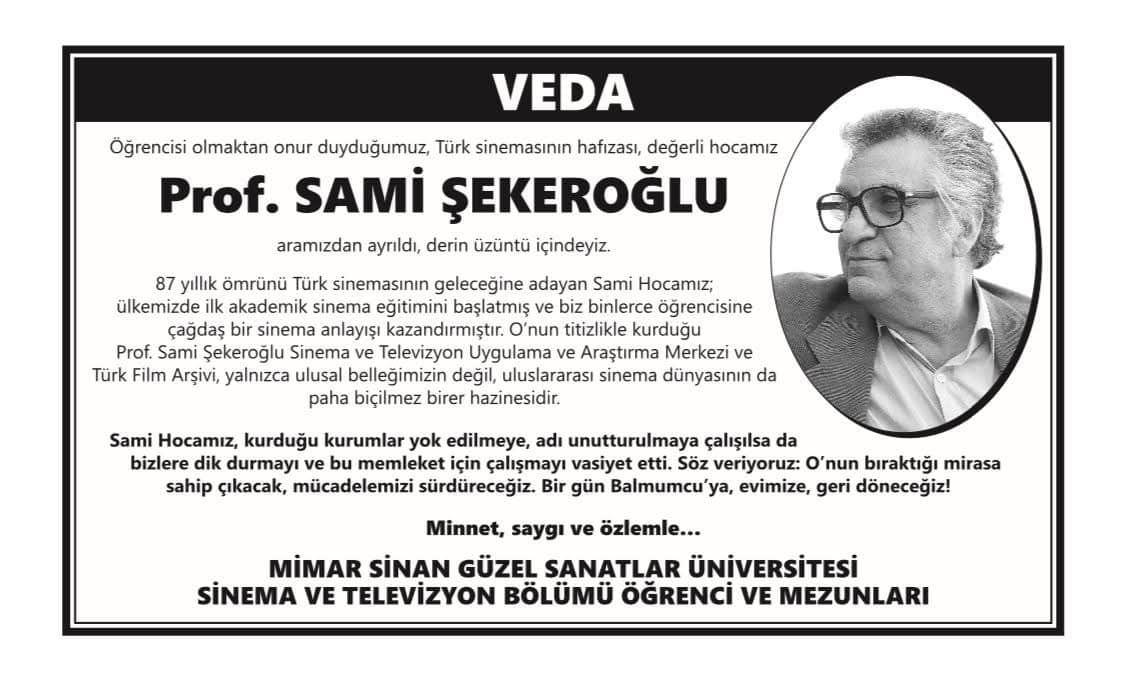
Sami Şekeroğlu Article by Atilla Dorsay[1]
The death of a cinema enthusiast and what it evoked
November 29, 20245
Apart from obituaries, it was never mentioned in the written
press or in the culture hours of TV. However, from a comprehensive perspective,
today, a significant part of the films before Yeşilçam, during and after it,
became ours thanks to Sami Şekeroğlu
Sami Şekeroğlu also died. Of course, those who know him know
that; when it comes to the Seventh Art, it is not only those who think of the
bright past of cinema art, its attractive stars, its genius creators... He was
a person who devoted himself to it and as a result, made a great contribution
to it becoming the Seventh Art.
Sami Şekeroğlu was one of those exceptional people. If we
start with the classic biographical information... He was born in Elazığ in
1937 (two years older than me). He graduated from the State Fine Arts Academy
(later Mimar Sinan University), which was also known as the one I studied at,
in the Painting Department (I studied in the Architecture Department). There,
he took lessons from names such as Bedri Rahmi Eyüboğlu, Ahmet Kutsi Tecer (who
was also my teacher), and Ali Avni Çelebi. He met names such as Fazıl Hüsnü
Dağlarca and Abdi İpekçi and wrote articles for Yön Magazine.
A period of discussion
As I wrote in my main biography titled Bir Ömürden Seçilmiş
Tablolar: Şekeroğlu, who founded the first cinema club of our country, Kulüp
Sinema 7, and the Turkish Film Archive affiliated with it, gathered all the
films he could find with the support of the university and established a real
Cinematheque. In those years when concepts such as National Cinema, socialist
cinema, and Islamic cinema were intensely discussed, there was the Turkish
Cinematheque Association, of which dear Onat Kutlar was among the founders.
We, the youth of the period (we are talking about the end of
the 60s), of course stood by Onat and the Sinematek Association: Leftism
required this due to the times!.. But we understood, albeit late, that the real
universal Sinematek concept was what Şekeroğlu did. Why did we realize later
that he had protected and preserved so many films and restored them whenever he
had the chance? Many years later, when I started my book 100 Turkish Films of
100 Years for the 100th anniversary of Turkish cinema, I again referred to
Şekeroğlu’s institution that has now settled in our collective memory. Here is
the section from the long INTRODUCTION text at the beginning of that book where
I once again mention Şekeroğlu:
From the preface of a book
“When I set out to write the book, I had said that I first
took refuge in the memories of my past experiences watching Turkish films. But
the most important thing was undoubtedly to find and watch the films of the
past. This required a lot of effort. Because most of them were lost, there was
very little chance of reaching the ones that were not lost. And from my
perspective, since we decided to publish the book at the beginning of 2014,
time was very short and precious. But I found and received the necessary help.
I would like to gratefully remember those who provided this help. First of all,
two institutions: as I have explained before, he founded a modest school
archive in the 1960s, which later became the unofficial (actually somewhat
official) Cinematheque of our cinema, which for years collected our old films,
regardless of whether they were negative or positive, wherever he found them
and put them in the archive; preserved them as a meticulous, passionate and
mysterious archivist; repaired them when he found the financial means... Prof.
Dr. Sami Şekeroğlu and the institution that eventually bore his name: Mimar
Sinan University Prof. Sami Şekeroğlu Cinema-TV Center. Which is now in the
safe hands of its new director Prof. Asiye Korkmaz and her friends.
I received great help from this institution and its
directors. And they provided a significant portion of the films I wanted. Thank
them, may they live long.”
My endless gratitude to him
I was going to thank Sami Şekeroğlu again for the repair
problems as follows:
“If we come to perhaps the most important aspect of the
subject… I believe that all the events to be held this year for the 100th
anniversary of our cinema will ultimately undertake an important task. Maybe I
am being overly optimistic, but let it be. In my opinion, all these events
(shows to be held by some institutions throughout the year, possible
publications, panels and discussions, special sections at festivals, etc.) will
ultimately create such public interest that the repair of at least some prominent
important films (and even the search and finding of copies) will come to the
agenda. And there will be a serious chance to save these films.
The real home of the work, Mimar
Sinan University Cinema-TV Center, is already preparing for a magnificent mass
show. The head of the institution, Prof. Sami Şekeroğlu, told me that they now
want to carry out the repairs on a larger scale. For this, they have purchased
a state-of-the-art film repair device from outside. With the meticulous
contribution of young expert students and the device in their hands, we all
watched as a very old newsreel was cleaned of stains and scratches as much as
possible. Thus, these repairs and digital transfers can now be carried out here
in the best way possible. Moreover, it is within the institution where our
films are archived and preserved in the most extensive way.
A period of debate
I wrote in my main biography
titled Selected Paintings from a Lifetime: Şekeroğlu, who founded our country’s
first cinema club, Kulüp Sinema 7, and the Turkish Film Archive affiliated with
it, gathered all the films he could find, with the support of the university,
and established a real Cinematheque. In those years when concepts such as
National Cinema, socialist cinema, and Islamic cinema were intensely discussed,
there was the Turkish Cinematheque Association, of which dear Onat Kutlar was
one of the founders.
We, the youth of the period (we
are talking about the end of the 60s), of course stood by Onat and the
Cinematheque Association: The period required this, leftism required it!.. But
we understood, albeit late, that the real universal Cinematheque concept was
what Şekeroğlu did. We later realized why he had taken so many films under his
protection, stored them, and restored them whenever he had the chance. Many
years later, when I began my book 100 Turkish Films of 100 Years for the 100th
anniversary of Turkish cinema, I had again referred to Şekeroğlu’s institution
that has now settled in our collective memory. Here is the section from the
long INTRODUCTION in the introduction of that book where I once again mention
Şekeroğlu:
From the foreword of a book
“When I set out to write the
book, I had said that I first took refuge in the memories of my past
experiences watching Turkish films. But undoubtedly the most important thing
was to find and watch the films of the past. This required a lot of effort. Because
most of them were lost, and there was very little chance of reaching the ones
that were not lost. And from my perspective, since we decided to publish the
book at the very beginning of 2014, time was very short and precious.
But I found and received the
necessary help. I would like to gratefully commemorate those who provided this
help. First of all, two institutions: As I have explained before, the modest
school archive he founded in the 1960s, which later became the unofficial
(actually somewhat official) Cinematheque of our cinema, which for years
preserved our old films, regardless of whether they were negative or positive,
wherever he found them and archived them; as a meticulous, passionate and
mysterious archivist; repairing when financial means are available... Prof.
Sami Şekeroğlu, who tried to do what French Henri Langlois, the pioneer and
creator of the Cinematheque concept in the world, did within the modest
conditions of our country, and the institution that finally bears his name:
Mimar Sinan University Prof. Sami Şekeroğlu Cinema-TV Center. Which is now in
the safe hands of its new director Prof. Asiye Korkmaz and her friends.
I received great help from this
institution and its directors. And they provided a significant portion of the
films I wanted. May they live long.”
My endless gratitude to him
I was going to thank Sami
Şekeroğlu again for the repair problems as follows:
“If we come to perhaps the most
important aspect of the subject... I believe that all the events to be held
this year for the 100th anniversary of our cinema will ultimately undertake an
important task. Maybe I am being overly optimistic, but never mind. In my
opinion, all these activities (shows to be held by some institutions throughout
the year, possible publications, panels and discussions, special sections at
festivals, etc.) will eventually create such public interest that the
restoration of at least some important films (or even the search for copies)
will be on the agenda. And there will be a serious chance to save these films.
The real home of the business,
Mimar Sinan University Cinema-TV Center, is already preparing for a magnificent
mass show. The head of the institution, Prof. Sami Şekeroğlu, told me that they
now want to carry out the repairs on a larger scale. For this, they have
purchased a state-of-the-art film repair device from outside. With the
meticulous contribution of the young expert students and the device in their
hands, we all watched as a very old newsreel was cleaned of stains and
scratches as much as possible. Thus, these repairs and digital transfers can
now be carried out in the best way here. Moreover, it is within the institution
itself where our films are most extensively archived and preserved.
Groupama’s Contribution
And I continued:
“Şekeroğlu is particularly happy
about the collaboration with the foreign institution Groupama. This large
international insurance company has been one of the leading supporters of
French Cinema since 1987 through its Gan Cinema Foundation. I think it does the
same thing in Turkey, where it has a large business volume, and since 2008, it
has been running a project called Turkish Classics Again at the International
Istanbul Film Festival. Starting from that year, the films Bereketli Topraklar
Ötesi, Vurun Kahpeye, Selvi Boylum Al Yazmalım, Üç Arkadaş, Gurbet Kuşları,
Vesikalı Yarim were repaired. For the current year of 2014, the film Muhsin Bey
was selected. As can be seen, almost all of them are important films that are
included in this book.
The group is now carrying out
this effort, which it started with Fono Film, at the Sami Şekeroğlu Cinema-TV
Center. And the results are extremely successful. Sami Bey explains that they
selected the films in cooperation with İKSV and that the repair took several
months. In addition, the method of this repair is explained in detail before
the credits of each film. I do not want to repeat it here. But I must say that
it was a difficult, delicate and expensive job. The result is magnificent. An
oldest film is reborn from its ashes, gaining the immortality of digital
technology. And an important page from both our national culture and social
history is revived.”
That is such a life
That is such a life...There are
few things more important and honorable than this!.. That is why his death was
a bitter surprise for us. We came together at the small but very cute Afet
Yolal Foundation Mosque in Levent. It was relatively crowded; but in my
opinion, it was insufficient... There were actually more cinema and art people
there that I would have liked to see...
Similarly, the public reflection
of his death was also insufficient. Apart from the obituaries, he was never
mentioned in the written press or during the culture hours of TV. However, from
a comprehensive perspective, today, a significant part of the films he made
before Yeşilçam, during and after it, became ours thanks to him. I tried to see
his family, especially his two daughters; but I couldn't. What can be said,
after that classic saying: May God have mercy on his soul...
________________________________________
[1] Who is Atilla Dorsay?
Atilla Dorsay was born in
Karşıyaka, İzmir in 1939. His childhood was spent during the difficult war
years. He remembers that everything was bought with ration cards, the war news
broadcast on the radio and the films about war that were his first cinema experiences.
When he was 10, his family
migrated to Istanbul just to send him to Galatasaray High School. Thus, he was
raised with French culture.
He studied architecture at the
Academy of Fine Arts (now Mimar Sinan University). He says that he owes his
aesthetic perspective, which he has preserved under all circumstances in life,
to this foundation.
He worked as a guide, journalist
and critic.
He continued his writings in
Cumhuriyet newspaper, which he started in 1966, for 27 years.
He married Leman Dorsay during
this period. He had two children and three grandchildren.
In the following years, he left
Cumhuriyet of his own volition. For a short time, he continued as a magazine
writer in Milliyet, which he still continues.
He experienced the joy of
creating a brand new newspaper in Yeni Yüzyıl. Later, he continued in Sabah
newspaper. He left here, in his own words, "with a principled
attitude": In one of his articles, he said, "Emek Yok Yok Ben
Yokum" to keep a promise he had made to his readers about Emek cinema.
Dorsay has been writing for T24
since 2013, which he points out with the words "Free, free, without any
restrictions on subject, place or time... But now without a salary!.. And very
soon it will be ten years..."
Dorsay has made efforts in many
areas related to culture and arts. He worked at İKSV and was a member of the
Istanbul Cinema Festival staff for years. He presented countless celebrities
from all over the world at press conferences, gave interviews and took their
photographs.
He both produced weekly music
programs and presented films on TRT. Especially in 1995, when the 100th
anniversary of cinema was celebrated, and afterwards, he introduced countless
classics together with young colleagues such as Murat Özer, Alin Taşçıyan and
Müjde Işıl.
He founded the Cinema Writers
Association (SİYAD) and served as its president for many years. He presented
award nights with carefully selected presenters and musicians. Again in his own
words; "when the time came, he did not neglect to leave all these duties
to his young friends."
Dorsay's greatest productions
are his books. He has collected all the films he has criticized since the
1970s, classified as Turkish and foreign cinema, in many books. These books are
an inventory of the last 50 years.
He also wrote about Istanbul,
Beyoğlu, urban planning; biographies (especially Türkan Şoray and Yılmaz
Güney), interviews, travel notes, stories, and even poems.
He published a work in which he
presented his interest in music with a magnificent archive. This book,
published under the title Ne Şurup Şeker Şarkılardi Onlar, tells the history of
20th century pop music.
His book, Arguments, Polemics,
Fights, was published in September 2022.
The number of his books has now
exceeded 60, but he has countless other projects. T24 Articles - Towards the
Pandemic Days: Art and Politics met with the reader in October 2023,
"Unutulmaz İnsanmızla Konuşlar" and "Benim '6 Silahşörler'im"
met with the reader in 2024. Many more will follow. As he said, "God
willing!"
Bir sinema tutkulusunun ölümü ve düşündürdükleri
Ölüm ilanlarının dışında ne yazılı basında ne de TV’lerin
kültür saatlerinde hiç anılmadı. Oysa kapsayıcı bir bakışla, bugün Yeşilçam
öncesi, kendisi ve sonrasındaki onca filmin önemli bir bölümü, bugün Sami
Şekeroğlu sayesinde bizim olmuştu
Sami Şekeroğlu da öldü. Onu elbette bilenler bilir; sinema
sanatının o parlak geçmişini, çekici yıldızlarını, dahi yaratıcılarını, Yedinci
Sanat denince tek akla getirenler değil... Kendisini ona adamış ve sonuç olarak
gerçekten Yedinci Sanat olmasına büyük katkısı olmuş bir insandı.
Sami Şekeroğlu işte o müstesna kişilerden biriydi. Klasik
biyografik bilgilerden başlarsak… 1937’de (benden iki yaş büyük) Elazığ’da
doğmuş. Benim de okuduğum o dönemki adıyla Devlet Güzel Sanatlar Akademisi’ni
(sonrasının Mimar Sinan Üniversitesi) Resim bölümünde olmak üzere bitirmiş (ben
mimarlık bölümünde okumuştum.) Orada Bedri Rahmi Eyüboğlu, Ahmet Kutsi Tecer
(benim de hocamdı), Ali Avni Çelebi gibi isimlerden ders almış. Fazıl Hüsnü
Dağlarca, Abdi İpekçi gibi isimlerle tanışarak Yön Dergisi'nde yazılar yazmış.
Sami Şekeroğlu
Bir tartışma dönemi
Bir Ömürden Seçilmiş Tablolar adlı esas biyografimde
yazmışımdır: Ülkemizin ilk sinema kulübü olan Kulüp Sinema 7 ve ona bağlı olan
Türk Film Arşivi’ni kuran Şekeroğlu, üniversiteyi arkasına alarak bulabildiği
tüm filmleri toplamış ve gerçek bir Sinematek kurmuştu. Ulusal Sinema, toplumcu
sinema, İslami sinema gibi kavramların yoğun biçimde tartışıldığı o yıllarda,
sevgili Onat Kutlar’ın da kurucuları arasında olduğu Türk Sinematek Derneği
vardı.
Biz dönem gençleri (60’ların sonundan söz ediyoruz) elbette
Onat’ın ve Sinematek Derneği’nin yanında yer almıştık: Dönem gereği, solculuk
bunu gerektiriyordu!.. Ama asıl evrensel Sinematek kavramının Şekeroğlu’nun
yaptığı iş olduğunu geç de olsa anladık.
Onca filmi koruması altına alıp sakladığı ve fırsat buldukça onardığını
neden sonra fark etmiştik. Uzun yıllar sonra, ben Türk sinemasının 100. yılı
için 100 Yılın 100 Türk Filmi kitabıma giriştiğimde, yine Şekeroğlu’nun o artık
ortak belleğe yerleşmiş kurumuna başvurmuştum. İşte o kitabın girişindeki uzun
SUNUŞ yazısından yine Şekeroğlu’nu andığım bölüm:
Bir kitabın önsözünden
“Kitabı yazmaya koyulurken, öncelikle geçmiş Türk filmleri
izleme deneylerimin anılarına sığındığımı söylemiştim. Ama kuşkusuz en
önemlisi, geçmişin filmlerini bulup izlemekti. Bunun için de hayli çaba
göstermek gerekiyordu. Çünkü bunların büyük bölümü kayıptı, kayıp olmayanlara
ulaşma şansı çok azdı. Ve de benim açımdan, kitabı 2014’ün hemen başlarında
çıkarmaya karar verdiğimiz için, zaman çok az ve değerliydi.
Ama gereken yardımı buldum ve de aldım. Bu yardımı yapanları
minnetle anmak istiyorum. Başta iki kurum: daha önce anlattığım gibi 1960’larda
alçakgönüllü bir okul arşivi olarak kurduğu, sonra sinemamızın gayriresmi
(aslında biraz da resmi) Sinematek’ine dönüşen, yıllar boyu eski filmlerimizi
negatif-pozitif demeden nerede bulursa alıp arşive koyan; titiz, tutkulu ve
gizemli bir arşivci olarak koruyan; maddi imkânlar bulduğunda onartan... Dünya
üzerinde Sinematek kavramının öncüsü ve yaratıcısı Fransız Henri Langlois’nın
yaptığını ülkemizin mütevazı koşulları içinde yerine getirmeye çalışan Prof.
Sami Şekeroğlu ve onun sonunda kendi adını taşıyan kurumu: Mimar Sinan
Üniversitesi Prof. Sami Şekeroğlu Sinema-TV Merkezi. Ki şimdilerde yeni
yöneticisi Prof. Asiye Korkmaz ve arkadaşlarının emin ellerindedir.
Bu kurumdan ve yöneticilerinden büyük yardım gördüm. Ve
istediğim filmlerin önemli bölümünü sağladılar. Sağ olsunlar, var olsunlar.”
Ona olan bitmeyen teşekkürüm
Onarım sorunları için yine Sami Şekeroğlu’na şöyle teşekkür
edecektim:
“Konunun belki en önemli yanına gelirsek… Ben bu yıl
sinemamızın 100. yılı dolayısıyla yapılacak olan tüm etkinliklerin, sonuç
olarak önemli bir işi yükleneceğine inanıyorum. Belki aşırı iyimserim, ama
olsun. Bana göre, tüm bu etkinlikler (kimi kurumların yıl boyu yapacakları
gösteriler, olası yayınlar, panel ve tartışmalar, festivallerde özel bölümler,
vs.) sonuç olarak öyle bir kamuoyu ilgisi yaratacak ki, en azından önde gelen
kimi önemli filmlerin onarımı (hatta kopyaların aranıp bulunması) gündeme gelecek.
Ve bu filmleri kurtarmak için ciddi bir şans doğacak.
İşin asıl yuvalarından Mimar Sinan Üniversitesi Sinema-TV
Merkezi, zaten görkemli bir toplu gösteriye hazırlanıyor. Kurumun başındaki
Prof. Sami Şekeroğlu, bana artık onarımları da daha büyük ölçekte
gerçekleştirme arzusunda olduklarını söyledi. Bunun için, dışardan en gelişmiş
bir film onarım cihazı almışlar. Genç uzman öğrenciler ve ellerindeki cihazın
özenli katkısıyla, hep birlikte çok eski bir haber filminin lekelerden ve
çiziklerden olabildiğince temizlenmesini izledik. Böylece artık bu onarım ve dijitale
aktarma işlemleri, burada en iyi biçimde yapılabiliyor. Üstelik zaten
filmlerimizin en geniş biçimde arşivlenip korunduğu kurumun kendi bünyesinde.
Groupama’nın Katkısı
Ve şöyle devam ediyordum:
“Şekeroğlu özellikle Groupama adlı yabancı kurumla iş
birliğinden son derece mutlu. Bu büyük uluslararası sigorta şirketi,
bünyesindeki Gan Sinema Vakfı aracılığıyla 1987 yılından bu yana Fransız
Sineması’nın önde gelen destekçilerinden biri olmuş. Aynı şeyi, sanırım büyük
bir iş hacmine sahip olduğu Türkiye’de yapıyor ve 2008 yılından beri,
Uluslararası İstanbul Film Festivali’nde Türk Klasikleri Yeniden adlı bir proje
yürütüyor. O yıldan başlayarak Bereketli Topraklar Üzerinde, Vurun Kahpeye,
Selvi Boylum Al Yazmalım, Üç Arkadaş, Gurbet Kuşları, Vesikalı Yarim filmleri
onarıldı. İçinde bulunduğumuz 2014 yılı içinse Muhsin Bey filmi seçildi.
Görüldüğü gibi, hemen hepsi bu kitaba da giren önemli filmler.
Grup Fono Film’le başladığı bu çabayı, artık Sami Şekeroğlu
Sinema-TV Merkezi’nde yürütüyor. Ve sonuçlar son derece başarılı. Sami bey
filmleri İKSV’nin de iş birliğiyle birlikte seçtiklerini ve onarımın birkaç ay
sürdüğünü açıklıyor. Ayrıca her filmin jenerik öncesinde, bu onarımın yöntemi
uzun uzun anlatılıyor. Burada yinelemek istemiyorum. Ama zor, incelikli ve
pahalı bir iş olduğunu söylemeliyim. Sonuç muhteşem. En eski bir film yeniden
küllerinden doğuyor, dijital teknolojinin ölümsüzlüğüne kavuşuyor. Ve hem
ulusal kültürümüzden hem de toplumsal tarihimizden önemli bir sayfa yeniden
canlanıyor.”
İşte böyle bir yaşam
İşte böyle bir yaşam...Bundan önemlisi ve onur vericisi az
olur!.. Onun için ölümü bizim için acı bir sürpriz oldu. Levent’teki küçük, ama
çok şeker Afet Yolal Vakfı Camiinde biraya geldik. Görece kalabalık; ama bence
çok yetersiz... Orada görmeyi isteyeceğim daha çok sinema ve sanat insanı vardı
doğrusu...
Şekeroğlu'nun cenaze
töreninden
Aynı biçimde, onun ölümünün kamuoyundaki yansıması da çok
yetersizdi. Ölüm ilanlarının dışında ne yazılı basında ne de TV’lerin kültür
saatlerinde hiç anılmadı. Oysa kapsayıcı bir bakışla, bugün Yeşilçam öncesi,
kendisi ve sonrasındaki onca filmin önemli bir bölümü, bugün onun sayesinde
bizim olmuştu. Ailesini, en çok da iki kızını görmeye çalıştım; ama
beceremedim. Ne denir, o klasik sözden sonra: Allah rahmet eylesin...
________________________________________
Atilla Dorsay kimdir?
Atilla Dorsay. 1939 İzmir, Karşıyaka'da doğdu. Çocukluğu zor
savaş yıllarında geçti. O yıllardan her şeyin karneyle alındığını, radyolardan
yayılan savaş haberlerini ve ilk sinema deneyimlerini oluşturan savaş üzerine
filmleri hatırlıyor.
10 yaşındayken ailesi sırf onu Galatasaray Lisesinde
okutabilmek için İstanbul'la göç etti. Böylece Fransız kültürüyle yetişti.
Güzel Sanatlar Akademisi'nde (şimdiki Mimar Sinan
Üniversitesi) mimarlık okudu. Hayatta her koşulda koruduğu estetik bakışını bu
temele borçlu olduğunu söyler.
Rehberlik, gazetecilik ve eleştirmenlik yaptı.
1966'da başladığı Cumhuriyet gazetesindeki yazılarını 27 yıl
boyunca sürdürdü.
Bu aralıkta Leman Dorsay'la evlendi. İki çocuk ve üç torunu
oldu.
Sonraki yıllarda Cumhuriyet'ten kendi isteğiyle ayrıldı.
Kısa bir süre için Milliyet'te devam eden ve hâlâ süren dergi yazarlığı yaptı.
Yeni Yüzyıl'da yepyeni bir gazeteyi yaratmanın keyfini
yaşadı. Daha sonra Sabah gazetesinde devam etti. Buradan kendi deyimiyle,
"ilkesel bir tavırla" ayrıldı: Bir yazısında, (Emek Yoksa Ben De
Yokum) okuruna Emek sineması üzerine verdiği bir sözü tutmak için.
Dorsay, 2013'ten beri, "Özgür, serbest, hiçbir konu,
yer ve zaman kısıtlamasına tabi olmadan... Ama artık maaşsız!.. Ve çok yakında
tam on yılını dolduracak olan..." sözleriyle işaret ettiği T24'te yazıyor.
Dorsay'ın kültür-sanata dair birçok alanda çabaları oldu.
İKSV'de çalışıp yıllar boyu İstanbul Sinema Festivali'nin kadrosunda yer aldı.
Dünya çapında sayısız ünlüyü basın toplantılarında sundu, söyleşiler yaptı,
fotoğraflarını çekti.
TRT'de, hem haftalık müzik programları yaptı, hem de filmler
sundu. Özellikle sinemanın 100. yılının kutlandığı 1995 yılı ve sonrasında
sayısız klasiği Murat Özer, Alin Taşçıyan, Müjde Işıl gibi genç
meslektaşlarıyla birlikte tanıttı.
Sinema Yazarları Derneği'ni (SİYAD) kurdu ve uzun yıllar
başkanlığını yürüttü. Ödül gecelerini özenle seçilmiş sunucular ve
müzisyenlerle sundu. Yine kendi sözleriyle; "zamanı geldiğinde tüm bu
görevleri genç arkadaşlarına bırakmayı da ihmal etmedi".
Dorsay'ın en büyük üretimleri kitapları. 1970'lerden
itibaren eleştirisini yazdığı tüm filmleri Türk ve yabancı sinema olarak tasnif
ederek pek çok kitapta topladı. Bu kitaplar, son 50 yılın bir dökümü niteliği
taşıyor.
Aynı zamanda İstanbul, Beyoğlu, şehircilik; biyografiler
(özellikle Türkan Şoray ve Yılmaz Güney), söyleşiler, seyahat notları, hikâye,
hatta şiirler de yazdı.
Müzik merakını görkemli bir arşivle birlikte sunduğu bir
eser yayımladı. Ne Şurup Şeker Şarkılardı Onlar adıyla yayımlanan bu kitap, 20.
yüzyıl pop-müzik tarihini anlatıyor.
Tartışmalar, Polemikler, Kavgalar adı kitabı Eylül 2022'de
yayımlandı.
Kitaplarının sayısı şimdilerde 60'ı aştı, ama daha sayısız
projesi var. T24 Yazıları -Pandemi Günlerine Doğru: Sanat ve Siyaset Ekim
2023'te, "Unutulmaz İnsanlarımızla Konuşmalar" ve "Benim Sevgili
‘6 Silahşörler’im" 2024'te okurla buluştu. Ardından daha birçoğu da
gelecek. Kendisinin dediği gibi "Allah kısmet ederse!.."