
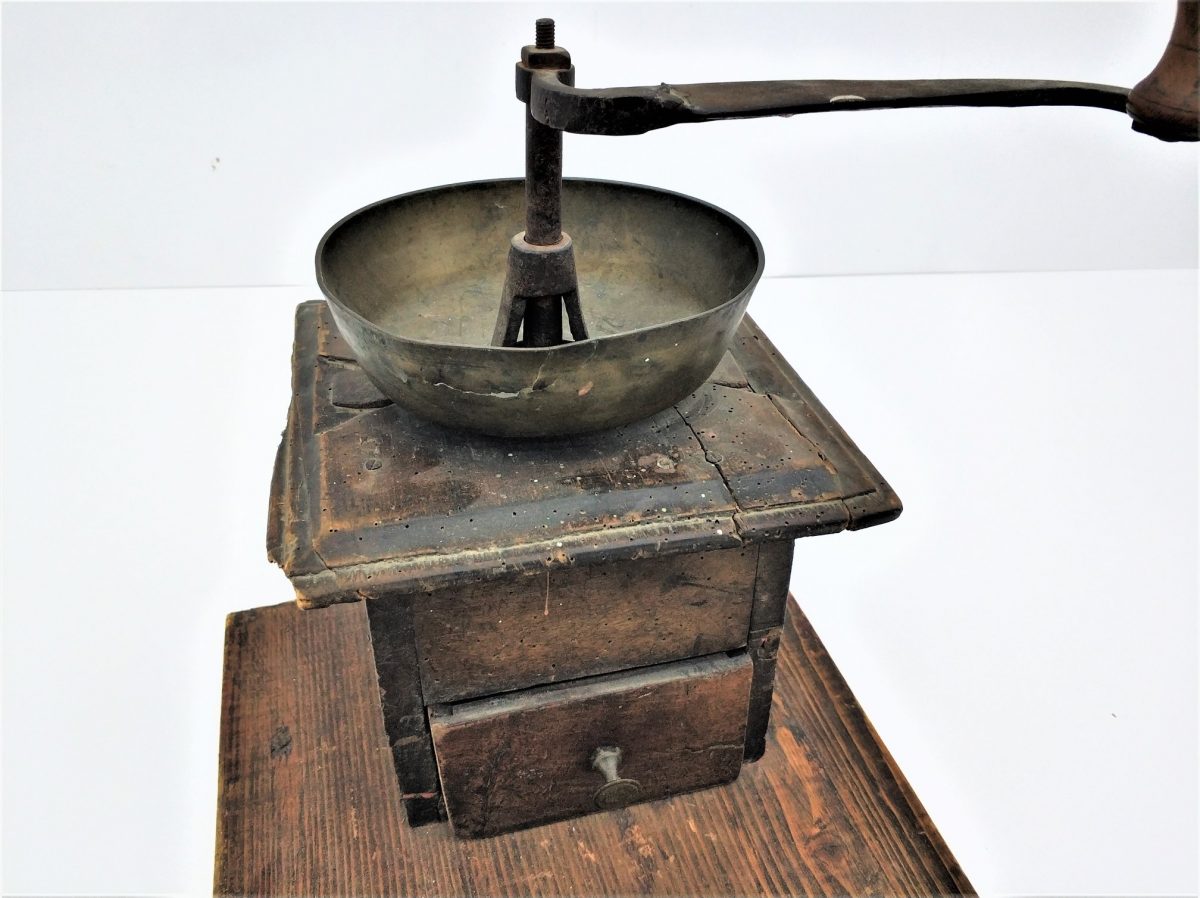


Device: coffee grinder | Date: 1925s | Brand: Haci Artin Movsessian and son

The documents accompanying the machine. Namely, the plate which presents the manufacturer and the cardboard box which contains it. These are unusual documents and you may notice one thing: The text is written in several languages including French but not English. Mr. Haci Artin.
Coffee is thought to have its origins in Ethiopia, spreading by the 15th century to Cairo and Mecca. From there, this hot beverage was adapted and spread throughout the Middle East. What is thought of today as Turkish coffee has its origins in Arabic coffee with the Turks learning the methods of preparation during the reign of the Ottomans.Coffee as a beverage became so ingrained in Turkish culture that the word for coffee, Kahve is the root of the word breakfast, or kahvalti meaning the meal is to be served "before coffee". While regional differences affect the coffee recipes used throughout the Middle East, the careful grinding and preparation that goes into every cup remains the same.

In the 1400s in Turkey and Persia (Iran), individual bean servings were roasted in small round perforated metal saucers and then ground in cylinder-shaped mills.
In the 1700s, a drawer was added to catch the grind below the blade. However, innovations were not widespread. As late as 1620, settlers brought a specialized mortar-and-pestle coffee grinder on the Mayflower to the Plymouth colony in Massachusetts.

A coffee grinder-boiler design from Damascus, Syria, in 1665 featured a folding handle and a cup-shaped bean bin. In 1905 a Coffee Mill patent designed by William Bussinger was registered by the United States Patent Office which consisted of a novel means for mounting the grinders and a bucket for catching grounds.
Turkish coffee was first introduced into Turkey around 1540 or so. History tells us that it was introduced by the Turkish Governor of Yemen - Ozdemir Pasha. He discovered a new beverage in his region, you get three guesses for what it might have been (hint, it was coffee). Wisely, he made sure to bring it to the attention of the Sultan, Suleiman the Magnificent.
The Sultan’s staff decided to try a new method for preparing the drink. They used mortars to finely ground the coffee and then brewed it using a special pot called an Ibrik. It was immediately a big hit in the palace and actually became an integral part of Turkish history and culture. The mansions of the elite were the first to get to try this great new beverage. Later it was consumed by the masses and eventually the whole Ottoman Empire.

(pictured: An American Patent for a coffee grinder)
The Turks invented the type of coffee mill and the Greeks copied the design of such hand made mills (i.e. the Alexander Company – 1977 to the present – website: brasspeppermill.com ) which markets their products under the Atlas, and Karyatis names, they have made a few noticeable minor improvements, and refinements to production of what they classify as their “Traditional Mills” in comparison to the original basic Turkish mill design they emulate that is currently still being hand produced for the most part by the various original, and still top family owned Turkish manufacturers of the mills, like Sozen, Zamak, and Acar.
The first step of preparing a delicious Turkish coffee
starts with the extraction of coffee beans. For this, instead of electric
coffee grinders, a manually driven coffee grinder made of brass is required.
The hand grinder is the only and most important tool that allows the coffee
bean to be held together in powder form instead of being crushed and dispersed,
without losing its pleasant smell. We should know that when we put the coffee
beans from the top and turn the upper handle arm with rhythmic movements and
start to smell the pleasant smell of that coffee, we have started to give the
first flavor to the coffee. After the coffee grinding process is finished, the
coffee that accumulates in the chamber at the bottom can be prepared in the
copper coffee pot.
TURKISH COFFEE GRINDER USE AND TIPS
Place your coffee beans into the hopper and close the lid.
Unfold and attach the handle to the rod in the center of the
grinder.
Make sure to have some coffee or spices in the hopper before
you start turning the handle.
Turn the handle clockwise and hold it below your hand/wrist
so that you are pushing down on it while turning the handle – this will make
sure that the handle does not come off. The handle conveniently folds in half
for easy storage in the upper hopper.
On your first use, it will take several turns before it
starts to grind; because the burrs are empty.
Adjust the coarseness by the screw/bolt at the bottom only when it is empty. The screw on the side of the grinder
You should not wash your coffee grinder. However, if you
must, make sure to dry it thoroughly to prevent any rusting.
Never use steel wool or abrasive pads to clean your
grinder.
You may use the commercially available cleaning materials
for metallic surfaces to clean the outside.
No comments:
Post a Comment