
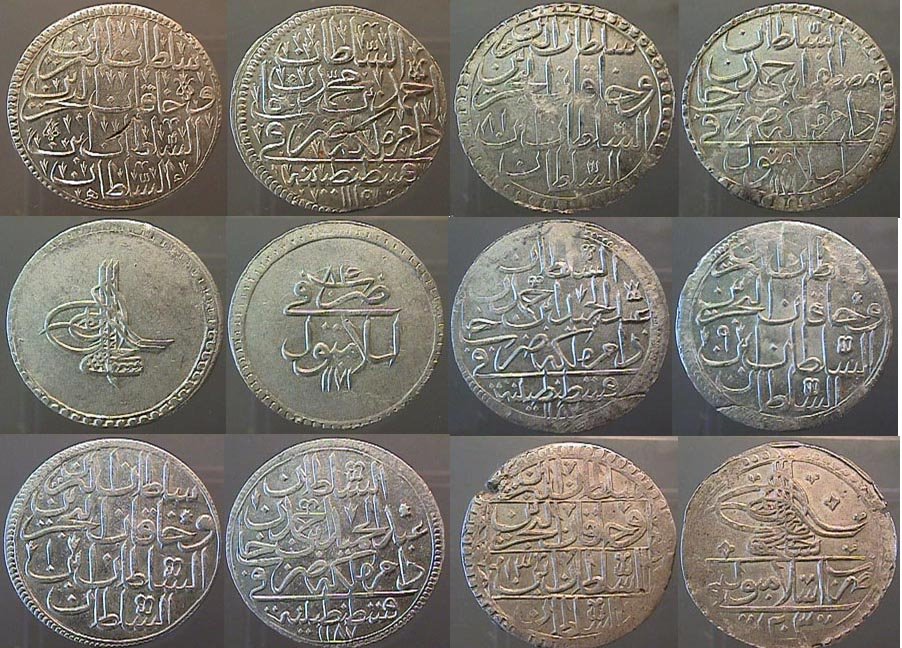
Zolota= 30 paras duribe fi Kostantiniye /minted in konstantiniyye
Mavi Boncuk
Mustafa II, AH 1110, AR zolota, Constantinople mint (19.40gm) Inscribed both sides.
Mustafa III, AH 1171, AR 2 zolota, Constantinople mint (27.94gm) similar.
Mustafa III AH 1171, AR piastre, Constantinople mint (18.39 gm) Toughra/Inscription.
Abdul Hamid I AH 1187, AR 2 zolotas, Constantinople mint (25.82 gm) Insc. both sides.
Abdul Hamid I AH 1187, AR zolota, Constantinople mint (14.25 gm) Insc. both sides.
Selim III, AH 1203, AR yuzluk, Constantinople mint (32.29 gm) Toughra/Inscription.
the Ottomans, in the early years of their rule, inscribed their coins in the traditions of the 'Umayyads, the Abbasids and other dynasties of Muslim history, the Sultans, starting in the 15th century, began to add their own names, the place of mintage and, frequently, the date. As the Ottoman Empire endured nearly five centuries, the coins provide a fine record of the Sultans from the time the Ottomans first established an organized coinage throughout their expanding empire.
This organized coinage was first introduced by the Sultan Orkhan in 1328; it was a silver coin called the akce and it weighed approximately one third of the earlier Islamic dirhams. In 1655, the Ottomans added a smaller silver coin called the para and in 1687 replaced the akce with a larger coin called the piastre - a term possibly derived from the French word piastre, meaning thin metal plate. The piastre was closer in size to the coin called the thaler or taler, which was, in various versions, the standard coin of Europe's Germanic states from the 15th to the 19th centuries, but it was only two thirds the weight. The piastre was at first worth 40 paras, but increased in value when Sultan Mustafa II issued still another variety - this one approximating the size and weight of the now-standard thaler. By then the Sultans had also begun to add what is called the tughrah, the elaborately calligraphed signature and emblem of the Sultan. The first tughrah appeared on the coins of Suleiman the Magnificent in the 16th century and was a regular feature by the time of Muhammad III (1595-1603).
A typical piastre of Mustafa II had four-line inscriptions in Turkish on each side, with one side reading "Sultan of the two lands and Khaqan of the two seas, Sultan, son of a Sultan," and the other reading "Sultan Mustafa, son of Muhammad Khan, may his kingdom continue." Because the location of the mint was also included, collectors know that the same coin was struck at Edirne, Izmir and Erzurum, as well as at Istanbul.
These piastres are generally inscribed with just one date, A.H. 1106 (A.D. 1695), the year of the Sultan's accession, regardless of the year in which they were actually minted. The piastres and other silver coins issued by later Sultans, however, were clearly inscribed with two dates: the date of the ruler's accession and the year in which the coin was actually struck.
With respect to history the method of dating is particularly interesting; it is expressed in terms of a "regnal year" - that is, the number of years the Sultan had been in power when the coin was struck. Thus, if the regnal year is 6, then that figure is added to the accession year to determine the coin's actual date. As Sultan Mustafa III, for example, reigned from 1757 to 1773, a piastre coin issued during his sixth regnal year carries the dates A.H. 1171 (A.D. 1757), when he acceded to power, and A.H. 1177 (A.D. 1763), the year the coin was struck.
For coin collectors, the regnal years on coins of the Near East are important since they help determine the current collectors' values, particularly the values of scarce varieties. The 20-piastre coins minted during the reign of Sultan Abdul Aziz (1861-1876), for example, were generally the same during the Sultan's 15-year reign and therefore are valued by collectors today at about $20. But the same 20-piastre coin minted in regnal year 4 is extremely scarce and catalogues at $70. Collectors who can read Arabic-Turkish numbers, therefore, are more likely to recognize the more elusive coins minted in regnal year 4.
Over the years, obviously, there were minor changes in Ottoman coinage: the shift from Koranic quotations to the Sultan's tughrahs, the introduction of the one-piastre coin and, later, the 20-piastre coin. And in the 18th century, a silver two-zolota coin was introduced.
See also: Coins and Currency of the Ottoman Empire by Şevket Pamuk
http://www.pierre-marteau.com/currency/coins/turk.html
No comments:
Post a Comment